Table of Contents
- Why B2B Pages Underperform With Good Traffic
- 30-Day Implementation Plan
- Common Failure Modes and Fixes
- FAQ
Most B2B teams are not blocked by traffic. They are blocked by post-click quality. Campaigns generate visits, but too many visitors leave without acting or submit forms that never become real opportunities. The gap is usually not one broken headline or one bad button. It is a system problem.
A high-performing B2B page does more than collect contacts. It helps the right buyer understand fit, evaluate risk, and choose the next step with confidence. When that decision sequence is clear, conversion quality improves and sales waste declines.
In Unicorn Platform, teams can operationalize this approach without rebuilding from scratch for every campaign. The value is fast execution with structural consistency: stable templates, controlled variants, and measurable learning cycles.
sbb-itb-bf47c9b
Quick Takeaways
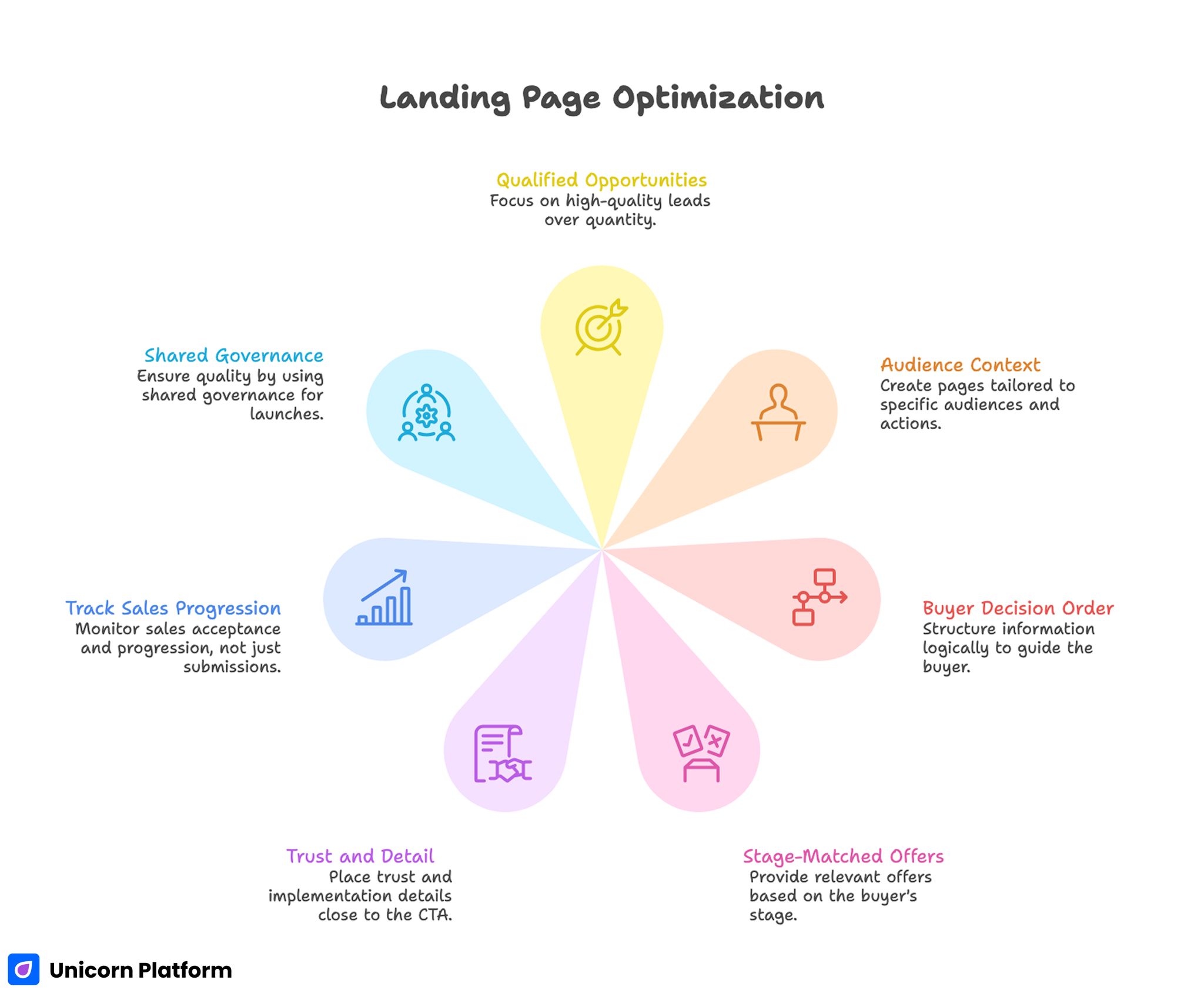
Landing Page Optimization
- Optimize for qualified opportunities, not raw lead counts.
- Build one page for one audience context and one primary action.
- Sequence information by buyer decision order: fit, trust, feasibility, commitment.
- Use stage-matched offers instead of one CTA for every visitor.
- Keep trust and implementation detail near action points.
- Track sales acceptance and progression, not just form submissions.
- Use shared governance so launch speed does not reduce quality.
Why B2B Pages Underperform With Good Traffic
B2B pages often underperform because messaging tries to serve too many stakeholders at once. A technical evaluator, budget owner, and end-user champion have different concerns. If a page blends all concerns into generic copy, no stakeholder feels fully addressed.
Another cause is stage mismatch. Early visitors are pushed toward high-commitment actions before they trust the solution. Late-stage visitors are forced through broad education they no longer need. Both groups experience friction, just in different places.
This challenge reflects broader trends in B2B buying behavior. Research from Gartner shows that modern B2B purchase decisions often involve multiple stakeholders evaluating solutions from different perspectives, including technical, operational, and financial concerns. When landing pages attempt to address all of these roles with generic messaging, they often fail to give any individual stakeholder the confidence needed to move forward.
Operational drift is the third cause. As campaigns scale, proof blocks go stale, CTA logic changes inconsistently, and form requirements drift across variants. This creates unpredictable conversion quality even when channel targeting remains strong.
Buyer Decision Sequence for B2B Conversion
High-quality B2B conversion usually follows four decisions. First: is this relevant to my context. Second: can I trust this team and product. Third: is implementation feasible in my environment. Fourth: is the next action worth taking now.
Page structure should mirror this order. Relevance comes first, then confidence, then practical rollout clarity, then action. Pages that reverse this order often produce vanity activity rather than pipeline.
This sequence also clarifies team roles. Product marketing owns relevance clarity. Growth owns experiment design. Product and solutions teams validate feasibility claims. Sales validates commitment-stage quality.
One Primary Outcome Per Page
Every landing page needs one dominant conversion objective. Trying to optimize equally for demo requests, trial starts, and newsletter signups usually weakens all of them.
Choose the objective based on campaign purpose and buyer readiness. For sales-led motions, prioritize qualified demo flow. For hybrid motions, route explicitly by intent and keep each route coherent.
A clear primary objective improves decision quality across the entire workflow: copy hierarchy, form depth, trust placement, and metric interpretation.
Role-Specific Messaging Without Template Chaos
Role-specific messaging is necessary, but fully custom page stacks are hard to maintain. The practical model is stable structure with variable emphasis.
Keep one shared architecture and adapt high-impact surfaces by role. Typical surfaces are hero framing, proof examples, and CTA language. Keep trust modules, navigation logic, and form standards consistent.
This approach improves relevance while preserving governance and measurement comparability.
First-Screen Strategy for High-Intent B2B Traffic
The first screen must answer three questions quickly: what this solves, who it is for, and what to do next. If these answers are vague, high-intent visitors continue evaluating elsewhere.
The importance of a strong first-screen experience is supported by broader conversion research. According to Forrester, B2B buyers increasingly expect immediate clarity about value, relevance, and next steps when evaluating vendors online. When landing pages fail to communicate these signals quickly, buyers often return to search results or continue comparing alternatives before engaging further.
Use a concrete outcome statement tied to business context, not abstract transformation language. Add one support line that reduces likely hesitation and one primary CTA with explicit action.
Avoid first-screen overload. Multiple offers and equal-priority actions reduce clarity and slow decision momentum.
Trust Architecture That Supports Conversion Quality
Trust should be layered across the page rather than isolated in one testimonial section. Early trust can come from clear fit and credible framing. Mid trust comes from proof and practical implementation signals. Late trust comes from policy, support, and risk controls near action zones.
Logo walls are useful but limited. Buyers also need evidence of adoption reality: deployment expectations, stakeholder involvement, and support accountability.
For teams improving trust placement and decision flow, this CRM conversion page guide can help structure proof around action points.
Implementation Feasibility as a Conversion Lever
Many B2B visitors hesitate not because value is unclear, but because rollout risk is unclear. If implementation feels disruptive, conversion stalls.
Pages should explain practical rollout path: who is involved, what the first phase looks like, and how existing systems are handled. This reframes adoption from risky unknown to manageable process.
Feasibility content should be concise and actionable. Overly technical detail can be moved to deeper resources, but baseline clarity must appear before commitment CTAs.
Offer Design by Funnel Stage
Offer strategy should reflect readiness stage. Early-stage traffic may convert better with educational tools and structured guides. Mid-stage traffic may need proof-rich comparison and implementation context. Late-stage traffic needs confidence and direct access to high-value conversation.
One generic offer across all stages usually lowers quality. Stage-specific offers improve both conversion relevance and downstream sales efficiency.
When designing demand pathways for SaaS-like B2B motions, this lead generation strategy framework is useful for mapping offer type to qualification outcome.
Form Strategy for Qualification and Completion Balance
Form design should support routing accuracy without adding unnecessary friction. Overly short forms increase low-fit volume. Overly long forms suppress valid intent.
Use staged capture. First touch collects routing-critical fields only. Deeper discovery can happen in follow-up once intent is established.
Field-level governance matters. Every required field should have a clear purpose tied to sales prioritization or response quality.
Navigation Design for Decision Progress
Navigation should help buyers reach critical confidence information quickly. It should not mirror internal team structures.
Prioritize routes tied to buyer decisions: fit, implementation, pricing clarity, trust and security context, and next-step options. Keep secondary routes available without competing for early attention.
A clear navigation system reduces pogo behavior and increases meaningful interaction depth before conversion events.
Procurement and Security Confidence Blocks
Procurement-influenced buyers often screen risk early. If pages hide governance and security context, qualified visitors may exit before engaging sales.
Use progressive disclosure. Provide concise confidence signals on main page and deeper detail in linked resources. This supports both quick evaluation and detailed review without clutter.
Commercial clarity is part of trust too. Buyers need predictable expectations around engagement process and next-step scope.
Mobile Behavior in B2B Journeys
B2B research increasingly starts on mobile. Weak mobile clarity can reduce consideration before desktop conversion even begins.
Mobile launch checks should include readable value framing, visible action paths, stable trust cues, and form usability on small screens. Real-device validation is mandatory.
Mobile reliability is a conversion requirement, not a design polish item.
Channel-Specific Variants With Shared Governance
Paid search, paid social, partner traffic, and content referrals arrive with different expectations. A single page for all sources can underperform, but fully custom pages create operational drift.
The balanced model is one template system with source-specific emphasis changes. Keep structure stable and adapt only high-impact message surfaces.
This allows teams to learn across channels without losing brand coherence.
Pipeline-Centric Metrics Tree
Form submissions are not enough. A quality metrics tree should connect page behavior to pipeline outcomes.
Top metric can be accepted opportunities by source. Supporting metrics include MQL-to-SQL progression and stage velocity. Diagnostic metrics include section interaction, form drop-off, and device behavior.
Use threshold rules so teams act quickly when quality declines, even if lead volume appears healthy.
Experimentation Framework for Reliable Learning
Strong testing programs use one major variable per cycle, one primary metric, and one guardrail metric. Multi-variable releases create noisy attribution and weak decisions.
Guardrails are essential. A change that increases submissions but decreases sales acceptance is not a win.
Maintain an experiment register with hypothesis, audience, change scope, metric pair, confidence level, and rollout decision. This protects team memory and prevents repeated low-value tests.
Weekly Operating Rhythm
A practical weekly rhythm keeps optimization compounding. Monday: review quality metrics and sales feedback. Tuesday: prioritize one high-impact change. Wednesday: implement and QA in Unicorn Platform. Thursday: launch. Friday: assess signal quality and log decisions.
This cadence balances speed with control. It reduces reactive redesign behavior and improves repeatability.
Cross-functional participation is critical. Growth, product marketing, sales feedback, and QA each provide different signals needed for sound decisions.
Monthly Governance and Content Freshness
B2B pages decay when proof, screenshots, and implementation details go stale. Freshness governance should be scheduled, not ad hoc.
Run monthly reviews for high-traffic pages: validate claims, update proof context, and confirm CTA routes match current campaigns. Use decay scoring to prioritize updates with greatest conversion impact.
Assign section ownership for reliability. One owner for value narrative, one for proof integrity, one for form and routing quality, and one for release QA.
Stakeholder Matrix for Multi-Person Decisions
Most B2B deals involve multiple stakeholders. Pages should reflect this reality without becoming bloated.
Build a stakeholder matrix that maps concerns to visible sections. Technical stakeholders need integration and reliability context. Business stakeholders need outcome and rollout clarity. Executive stakeholders need risk and cost confidence.
A matrix-driven page helps buyers self-navigate and helps sales continue conversations with less re-education.
Sales Handoff and SLA Alignment
Conversion quality can degrade after form submission if response standards are unclear. Handoff design is part of page performance.
Define SLA rules for response timing, ownership, and minimum context provided to sales. Leads should include intent and interaction summary, not just contact details.
Track SLA adherence alongside page metrics. Slow or low-context follow-up can mask otherwise good conversion architecture.
Capacity-Aware Demand Planning
Demand growth plans should account for sales and onboarding capacity. Otherwise, improved conversion can overload teams and reduce quality.
Use a simple forecast model with conservative, expected, and upside scenarios. Tie scenario assumptions to actual execution bandwidth.
Prioritize backlog items that improve quality with manageable operational load before scaling high-volume changes.
Account-Focused and Self-Serve Path Coordination
Many B2B teams run account-focused programs and self-serve pathways at the same time. Problems appear when both motions push visitors into identical conversion flows. Enterprise evaluators receive low-context trial prompts, while exploratory users are forced into high-friction sales forms. The result is lower qualification quality on both sides.
A practical model uses one shared architecture with explicit branch points. Visitors with clear high-complexity signals can move into guided evaluation routes. Visitors with exploratory intent can move into lower-friction discovery paths. Both routes should keep consistent trust language and outcome framing so the brand feels coherent.
Route rules should be visible in page design, not hidden in backend logic only. If users do not understand what the next step includes, they hesitate or convert at low quality. Clear route descriptions increase confidence and help sales receive better context at handoff.
Measure each route separately. Account-focused routes should be evaluated by opportunity progression quality. Self-serve routes should be evaluated by activation depth and upgrade potential. Combining both in one aggregated conversion metric can hide meaningful failure signals.
Procurement and Legal Readiness Blocks
In many B2B categories, procurement and legal review are not end-stage concerns only. They influence early confidence. If page content ignores governance expectations, high-intent evaluators may delay engagement until they find more predictable vendor signals.
Add concise readiness blocks that explain practical review expectations: implementation scope, support model, contract process outline, and response windows for due diligence questions. This content should be clear enough for early evaluation without overwhelming first-time visitors.
Progressive disclosure works well here. Keep top-level readiness content short and actionable, then provide deeper resources for buyers who need detail. This structure supports both fast-moving evaluators and risk-conscious stakeholders.
Readiness content should also align with sales process design. If page language promises smooth procurement but internal response patterns are slow or inconsistent, trust declines quickly. Aligning page expectations with operational delivery improves conversion quality and shortens cycles.
Decision Log and Rollback Discipline
Optimization quality improves when teams document decisions consistently. Without a decision log, the same low-impact tests return under new names, and successful patterns are not standardized fast enough. A short log with clear fields prevents this waste.
Each entry should capture hypothesis, audience context, changed section, primary metric, guardrail metric, and final decision. The goal is operational memory, not long documentation. Teams should be able to understand past decisions quickly and build on them.
Rollback rules should be defined before launch for every major variant. If a guardrail is breached, the team should know exactly who can revert and how quickly that rollback happens. Delayed rollbacks can damage qualification quality for days before action is taken.
Phased rollout supports safer experimentation. Launch to a limited share first, validate signals, then expand. Combined with clear rollback ownership, this approach allows faster testing while protecting pipeline reliability.
Scenario: Mid-Market Pipeline Recovery
A mid-market B2B team had strong inbound volume but weak accepted-pipeline progression. Analysis identified broad messaging, delayed trust context, and inconsistent handoff logic.
The team moved to one canonical template in Unicorn Platform with role-specific emphasis variants. They tightened first-screen relevance, moved implementation trust earlier, simplified form fields, and introduced weekly sales-feedback mapping.
Within two months, accepted-lead quality and opportunity progression improved while low-fit submissions declined. The largest gains came from system consistency, not major visual redesign.
30-Day Implementation Plan
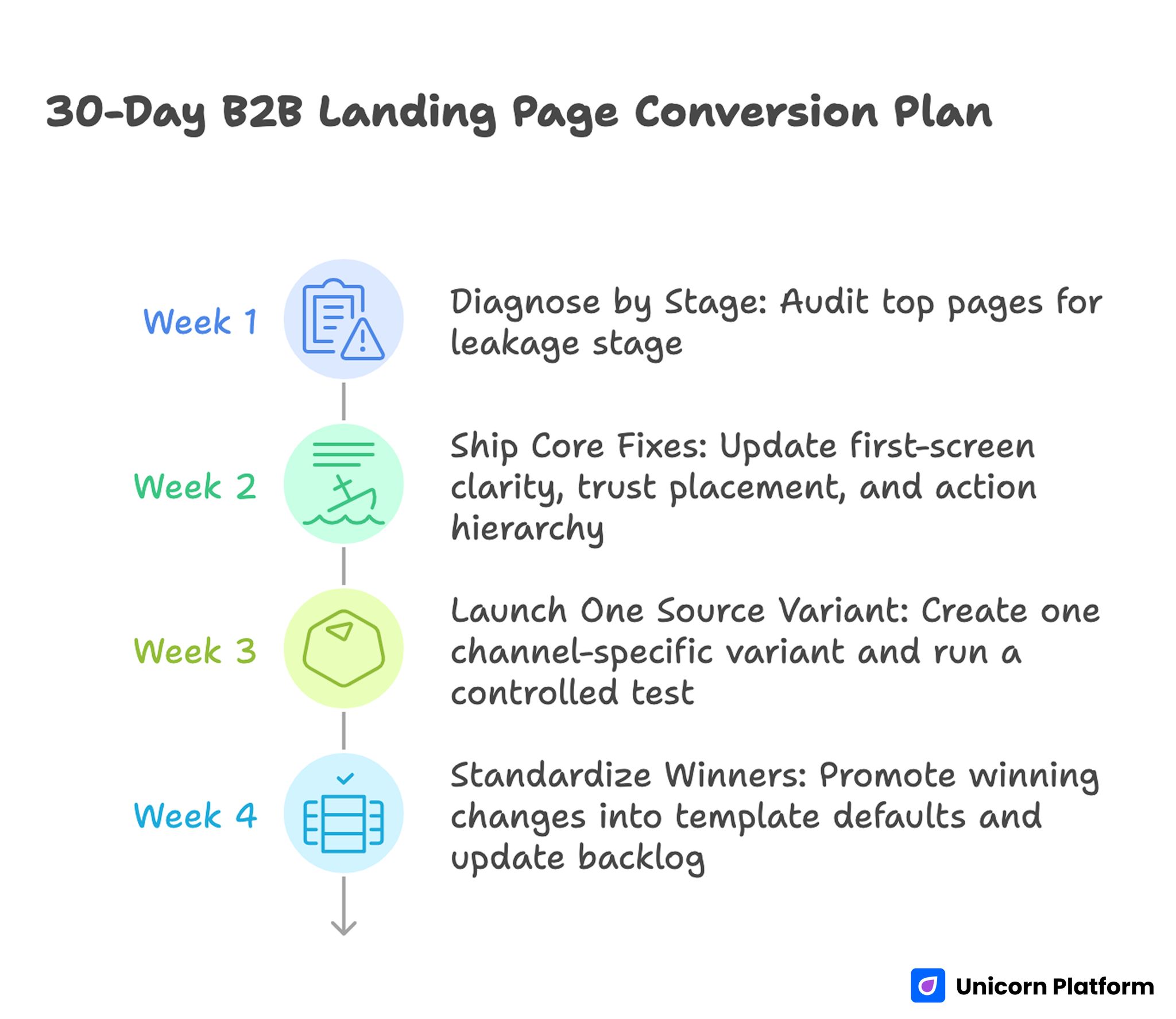
30-Day B2B Landing Page Conversion Plan
Week 1: Diagnose by Stage
Audit top pages for leakage stage: relevance, trust, or commitment. Select one baseline template and lock non-negotiable sections.
Week 2: Ship Core Fixes
Update first-screen clarity, trust placement, and action hierarchy. Validate mobile and form flow on real devices before scaling.
Week 3: Launch One Source Variant
Create one channel-specific variant from the same template. Change only high-impact emphasis and run one controlled test.
Week 4: Standardize Winners
Promote winning changes into template defaults. Archive weak experiments with rationale and update next-cycle backlog.
90-Day Scale Plan
Month 2: Expand Controlled Variants
Add role and source variants while preserving structure and QA standards. Continue one-variable tests with quality guardrails.
Month 3: Institutionalize Governance
Formalize template rules, metric thresholds, freshness cadence, and rollback triggers. Train contributors on ownership and release standards.
At this stage, success means faster launches with lower quality volatility.
Common Failure Modes and Fixes
1) Generic Messaging Across Roles
Problem: no stakeholder feels directly addressed. Fix: role-specific emphasis on a shared template.
2) Trust Signals Appear Too Late
Problem: visitors hesitate before confidence forms. Fix: move trust and implementation cues nearer to early decision points.
3) CTA Overload
Problem: too many equal actions reduce clarity. Fix: one dominant action with controlled secondary path.
4) Form Over-Collection
Problem: friction increases without better routing. Fix: keep only routing-critical fields at first touch.
5) Navigation Noise
Problem: decision-critical info is hard to find. Fix: prioritize routes by buyer decision sequence.
6) Testing Noise
Problem: multi-variable releases break attribution. Fix: one major variable per cycle with guardrail metric.
7) Weak Handoff Standards
Problem: quality leads cool before sales response. Fix: clear SLA and ownership for follow-up execution.
8) Metric Tunnel Vision
Problem: lead volume rises while pipeline quality drops. Fix: optimize for accepted opportunity and progression metrics.
9) Stale Proof
Problem: credibility declines from outdated evidence. Fix: monthly freshness audits with decay-priority updates.
10) Governance Drift
Problem: campaign speed creates inconsistent pages. Fix: enforce section ownership and release checklist.
Pre-Launch QA Checklist
Before launch, verify offer-message match, trust-proof recency, form logic, and action hierarchy. Ensure implementation clarity appears before high-commitment actions.
Validate mobile readability, navigation usability, and form completion on real devices. Confirm stage-level tracking and variant tags are accurate.
Require sign-off from growth, product marketing, and QA, with sales feedback review for high-impact variants.
FAQ: B2B Landing Page Conversion System
What should B2B teams optimize first?
Start with first-screen role-fit clarity and trust placement near early decisions.
How many CTAs should a page prioritize?
One primary CTA per page, with one secondary fallback where needed.
Which metric is most important?
A qualified pipeline metric tied to sales acceptance and progression.
Should every channel have a unique design?
No. Use one architecture and vary high-impact message emphasis.
How often should proof content be refreshed?
Review high-visibility proof monthly and update by decay priority.
How do we reduce low-fit form submissions?
Tighten role-fit messaging and simplify, but sharpen, first-touch qualification.
Are long forms always bad for B2B?
Not always, but first touch should collect only routing-critical data.
What is the biggest mobile mistake in B2B?
Assuming responsive layout equals conversion readiness.
How should teams handle underperforming variants?
Use predefined rollback triggers and phased release expansion.
What creates compounding gains over time?
Stable templates, disciplined testing, clear ownership, and quality-first metrics.
Final Takeaway
B2B conversion performance improves when pages are treated as operating systems, not one-off campaigns. Clear role-fit messaging, trust-aware sequencing, and controlled experiments produce higher-quality pipeline with less waste.
Unicorn Platform helps teams execute this model quickly while preserving consistency. Keep structure stable, vary emphasis intentionally, and measure outcomes by pipeline quality so gains compound over time.
Related Blog Posts
- Unlock the Secrets of High-Converting Landing Pages
- The Ultimate Guide to B2B Landing Pages: Best Practices, Examples, and Cost-Smart Execution
- Dashboard Landing Pages for Startups: How to Simplify Complex Products and Improve Conversion
- Lead-Generation Landing Pages in 2026: A Practical System for Higher-Quality Pipeline


