Table of Contents
- Why Agency Sites Underperform
- Case Study Architecture That Drives Qualified Interest
- 30-Day Optimization Plan
- Scenario Playbooks
- Common Mistakes and Fixes
- FAQ
Most creative studios do not struggle to make beautiful websites. They struggle to make clear ones. The site looks polished, animations feel premium, and portfolio visuals are strong, yet inquiry quality remains inconsistent. Visitors admire the work but leave uncertain about whether the agency is the right fit.
That gap usually comes from business clarity, not visual craft. Prospects need quick answers to practical questions: what kind of projects this team is best at, how engagements are structured, what outcomes are realistic, and what will happen after they submit an inquiry. If those answers are hard to find, conversion quality falls even when design quality is high.
In 2026, agency buyers evaluate faster and compare more sources before taking a call. They move across referrals, search, social, and portfolio directories, then decide within minutes whether a studio deserves deeper conversation. Sites that connect creative credibility with operational clarity consistently outperform sites that rely on aesthetic impact alone.
This guide is a practical system for doing that. It covers positioning, case-study structure, trust design, inquiry routing, AI-supported workflows, SEO alignment, and performance measurement so teams can improve both conversion rate and lead quality.
sbb-itb-bf47c9b
Key Takeaways
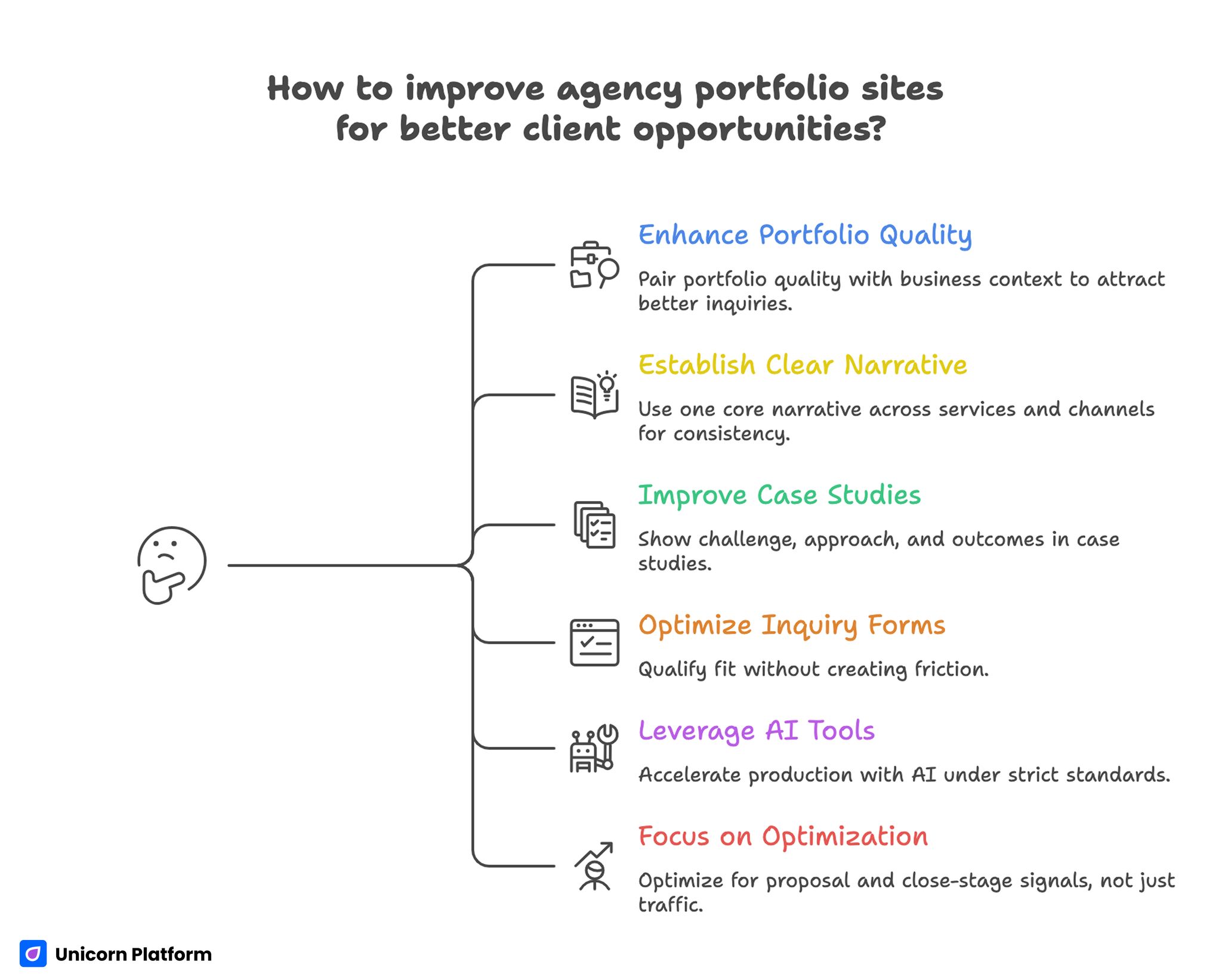
Improving Agency Portfolio Websites to Attract Better-Fit Clients and Increase High-Quality Opportunities
- Portfolio quality must be paired with business context to improve inquiry quality.
- High-performing agency sites use one clear narrative core across services and channels.
- Case studies should show challenge, approach, and outcomes, not visuals alone.
- Inquiry forms should qualify fit without creating early-stage friction.
- AI tools can accelerate production when guided by strict editorial standards.
- Monthly optimization should focus on proposal and close-stage signals, not traffic alone.
Why Agency Sites Underperform
A recurring failure pattern is portfolio-first storytelling without problem framing. Prospects see visual outcomes but not the business context that produced them. Without challenge and impact clarity, work looks impressive but hard to evaluate.
Another issue is broad service framing. Agencies list many capabilities without defining priority strengths, engagement model, or ideal client profile. This attracts mixed-fit traffic and increases low-context inquiries that waste sales effort.
Action design is also often weak. CTA language is generic, forms collect either too little or too much information, and post-submit expectations are unclear. Prospects who are interested may still postpone if next steps feel undefined.
Finally, teams often track top-of-funnel metrics and ignore commercial signals. Strong session metrics can coexist with weak proposal quality and low close rate if positioning and qualification are misaligned.
What "Best" Should Mean for Agency Sites
For creative teams, "best" should not mean trendiest layout or heaviest motion stack. It should mean faster buyer understanding, stronger trust, and cleaner transition into qualified conversations.
A high-performing agency site should achieve four things quickly. The list below can be used as a fast audit for existing pages.
- Clarify who you serve and what outcomes you deliver.
- Prove capability with context-rich evidence.
- Explain how projects work in practical terms.
- Route users toward one clear, intent-matched next step.
When these four elements are consistently implemented, visual quality becomes a force multiplier instead of a standalone asset. Teams usually see faster qualification gains because users can evaluate fit with less effort.
Positioning System: Define Fit Before You Showcase Work
Positioning clarity is the highest-leverage improvement for most creative studios. If prospects cannot identify fit quickly, they either bounce or enter calls with misaligned expectations.
A practical positioning framework includes audience definition, service scope, engagement style, and outcomes language. Each component should be specific enough to filter poor-fit inquiries while still leaving room for adjacent opportunities.
Start by naming your strongest context: industry niche, growth stage, or project category. Then define the typical business problems you solve and the strategic approach you use. This framing helps prospects decide whether your methodology matches their needs.
Positioning should be visible above the fold and reinforced in service and case-study pages. Repetition of clear positioning is not redundancy; it is trust-building consistency.
Case Study Architecture That Drives Qualified Interest
Case studies are the center of most agency buying decisions, but many are structured like galleries rather than decision assets. A stronger case format helps prospects evaluate fit without requiring a discovery call.
Use a consistent case framework. This structure helps both prospects and internal contributors evaluate work more clearly.
- Client context and constraints.
- Problem definition and business objective.
- Strategic hypothesis.
- Creative execution and key decisions.
- Results, impact, and tradeoffs.
- What would be done differently next time.
This structure demonstrates both craft and judgment. It also creates better internal discipline because teams must articulate why decisions were made, not just what was delivered.
If your team wants stronger clarity on visual and information hierarchy while building these pages, this guide on web page design fundamentals can help standardize layout decisions. Use it to reduce variation when multiple designers contribute to case templates.
Depth Standards for Portfolio Evidence
Not every project needs the same length, but each featured case should meet a minimum evidence threshold. Include enough context for prospects to understand fit, complexity, and execution quality.
A useful minimum set includes objective statement, scope boundaries, timeline context, collaboration model, and measurable outcomes where possible. When results are sensitive, discuss directional impact or qualitative outcomes with clear qualifiers.
Depth standards improve conversion quality because they reduce ambiguity before inquiry. They also improve team efficiency by reducing repetitive explanation during first calls.
Service Pages: Separate Offer Clarity From Portfolio Exploration
Many agency sites combine service explanation, portfolio highlights, and process details in one overloaded page. This can work for small studios with narrow scope, but it often creates confusion at scale.
Service pages should prioritize decision clarity. Explain what the service includes, who it is for, how engagements are structured, and what outcomes are realistic. Portfolio examples can support this narrative but should not replace it.
A practical service-page sequence is shown below. It keeps service clarity high without sacrificing narrative flow.
- Service outcome statement.
- Who this service is best for.
- Typical engagement scope.
- Delivery process and collaboration model.
- Proof highlights with context.
- Intent-matched CTA.
When this sequence is consistent, prospects self-qualify earlier and conversations begin at a more useful level. Sales teams spend less time reframing scope basics during first calls.
For teams that also run service-specific acquisition campaigns, this marketing agency landing page framework can help align campaign copy with consultation quality. It is especially useful when campaign promises and portfolio messaging need stronger continuity.
Trust Architecture Beyond Logos and Awards
Recognition signals can support credibility, but they rarely answer high-friction buyer questions by themselves. Prospects also want operational trust: how communication works, how feedback is handled, and how project risk is managed.
A stronger trust system includes the components below. Together they reduce buyer uncertainty before commitment.
- Process transparency.
- Role clarity on both sides.
- Revision and scope boundaries.
- Timeline expectations.
- Decision checkpoints and sign-off flow.
Include these elements near inquiry decisions, not buried in footer content. Trust is most useful when shown where commitment happens.
Testimonials should reflect concrete experiences like strategic clarity, collaboration quality, and delivery reliability. Generic praise is less persuasive than context-specific evidence.
CTA and Form Strategy for Better-Fit Leads
Generic CTA language often increases low-context responses. Action text should reflect user intent and engagement stage.
Examples of stronger CTA intent mapping are listed below. Specific actions help prospects choose the next step with less hesitation.
- Early stage: "Request project fit review"
- Mid stage: "Share your brief"
- High intent: "Book scoping call"
Forms should balance qualification and momentum. Ask for the details that affect fit and routing, but avoid unnecessary friction in first-step submission.
Useful first-step fields often include project type, timeline expectation, budget band, and primary goal. Additional detail can be captured after initial qualification.
Post-submit confirmation should set expectations for response time, next meeting format, and preparation guidance. Clear confirmations reduce anxiety and improve response rates.
Onboarding Clarity Before the Proposal Stage
A frequent conversion leak appears after inquiry, when prospects realize engagement expectations differ from their assumptions. Adding onboarding clarity to the website reduces this mismatch.
A concise onboarding section should explain kickoff sequence, communication cadence, review rounds, and required client inputs. This helps prospects self-assess readiness before committing to deeper conversations.
When onboarding expectations are visible early, teams often see fewer misaligned calls and cleaner proposal conversations. It also reduces internal strain because project-fit filtering happens earlier in the funnel.
AI-Assisted Portfolio Production Without Quality Drift
AI tools can speed up content scaffolding, case-study drafts, and portfolio organization. The risk appears when teams treat generated output as final narrative. That usually leads to generic language and weaker differentiation.
A practical model is to use automation for first-pass structure and reuse tasks, while human teams own strategic framing, voice, and client-sensitive storytelling. This keeps output fast while protecting differentiation.
For teams adopting this workflow, this overview of AI portfolio generation for startups is useful as a starting point for balancing speed with curation quality. Treat it as a production accelerator, not a substitute for narrative judgment.
Governance Rules for AI Use
Define allowed and restricted usage explicitly. Allowed usage can include layout ideation, outline generation, and initial summary drafting. Human-required steps should include positioning claims, nuanced case framing, and final CTA language.
Every AI-assisted output should pass editorial checks for factual precision, narrative originality, and brand voice consistency before publication. Review quality here determines whether speed gains convert into business gains.
Governance keeps automation useful and prevents erosion of the agency’s strategic edge. Clear rules also help new contributors produce consistent work faster.
SEO Strategy for Agency Demand Generation
SEO for agencies works best when portfolio pages are connected to educational and methodology content that addresses buyer intent directly. Prospects often research approach and fit before contacting a provider.
Build content clusters around practical buyer questions. The list below is a useful starting point for agency demand generation.
- Choosing agency scope by growth stage.
- Common project planning mistakes.
- Timeline and budget tradeoffs.
- How to evaluate strategic and creative fit.
Connect these pages to relevant services and case studies. Internal-link pathways should follow likely decision progression, not site hierarchy conventions.
Keep language natural and specific. Search performance improves when pages answer real questions better than alternatives, not when they repeat the same phrase mechanically.
Mobile Experience and Performance Priorities
Agency prospects often discover studios on mobile and return on desktop later. If first mobile interaction is unclear or slow, many never return.
Mobile-first checks should prioritize the items below. These checks catch conversion friction that desktop reviews often miss.
- Immediate positioning clarity.
- Early proof visibility.
- Readable case-study structure.
- Clear CTA access without long scroll dependency.
Visual richness should not block comprehension. Complex motion and heavy media can be effective, but only if they preserve load performance and decision clarity.
Measurement Model Tied to Revenue Quality
Traffic metrics alone cannot validate agency-site performance. Stronger measurement should connect page behavior to commercial outcomes.
A practical measurement stack includes the indicators below. These metrics link page performance to proposal and revenue quality.
- Case-study to inquiry transition rate.
- Service-page inquiry quality by source.
- Inquiry-to-qualified-call rate.
- Qualified-call to proposal rate.
- Proposal-to-close rate by entry page.
- Time-to-brief completion after inquiry.
This model helps teams identify where funnel quality breaks. If inquiry volume is high and close rate is low, positioning or qualification likely needs refinement.
Path-Level Analysis Over Page-Level Vanity
Review multi-page pathways instead of isolated page metrics. High-performing clients often consume several assets before inquiry. Understanding these sequences helps teams prioritize which pages to strengthen.
Use Guardrails in Optimization
Every primary metric should have a guardrail. For example, if inquiries increase but proposal quality declines, changes should be reconsidered even if top-line conversion improves.
30-Day Optimization Plan
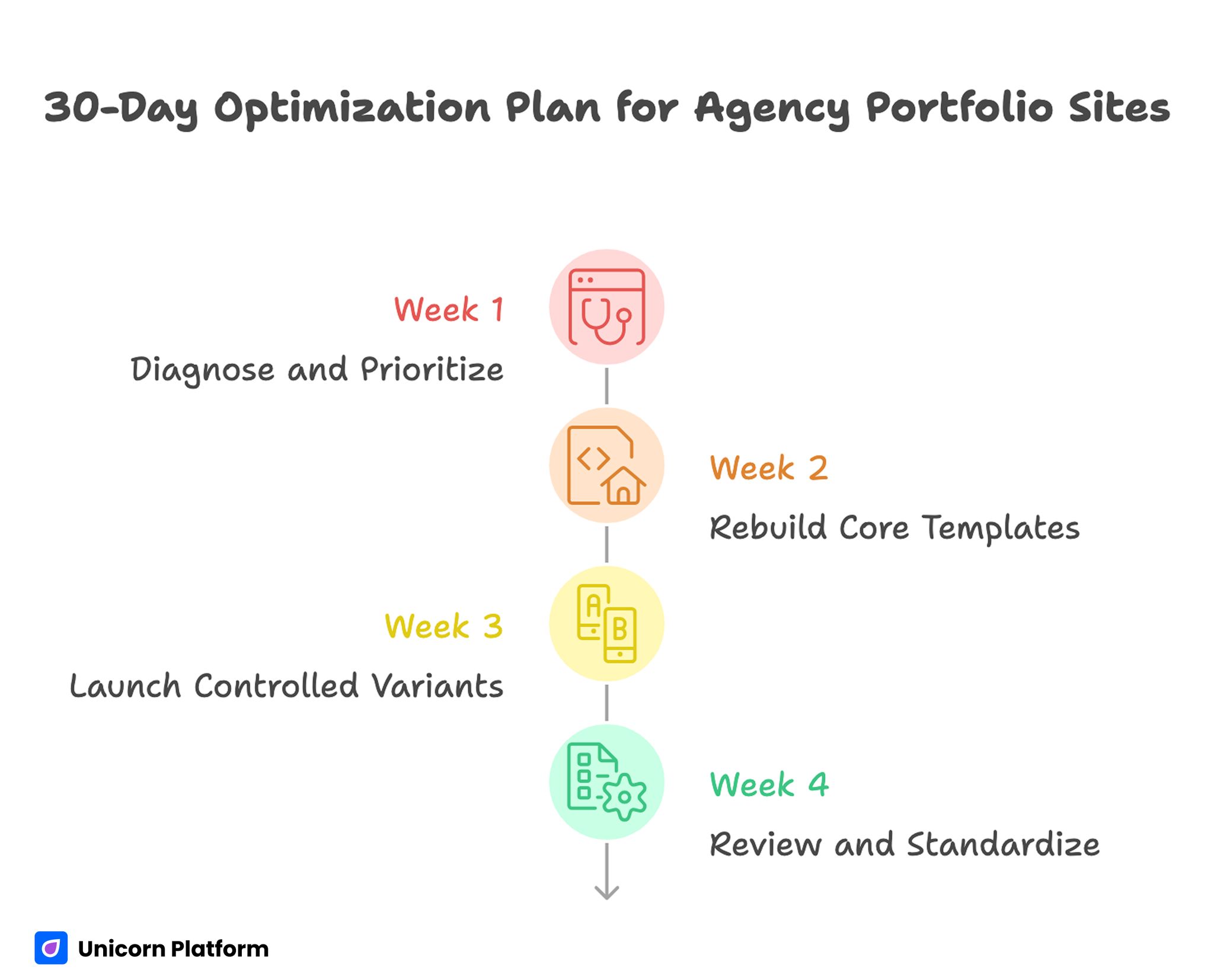
30-Day Optimization Plan for Agency Portfolio Sites
Week 1: Diagnose and Prioritize
Audit homepage, service pages, and top case studies for positioning clarity, proof depth, and CTA friction. Identify one major quality bottleneck per page type.
Week 2: Rebuild Core Templates
Create standardized templates for homepage narrative, service page structure, and case-study format. Add consistent trust and onboarding modules.
Week 3: Launch Controlled Variants
Deploy one positioning variant and one CTA-flow variant tied to a primary quality metric. Keep design variables stable so results are interpretable.
Week 4: Review and Standardize
Analyze inquiry quality and proposal progression signals. Promote winning changes to default templates and document one keep, one stop, and one next test.
Repeat monthly so improvements compound rather than reset between campaigns. Consistent cadence usually outperforms occasional large redesigns.
Scenario Playbooks
Scenario 1: High Portfolio Engagement, Low Inquiry Quality
A studio sees strong case-study engagement but receives vague project inquiries. Analysis shows case pages emphasize visual outcome while underexplaining challenge and scope context. Adding structured case narratives with business framing usually improves fit and reduces low-context outreach.
Scenario 2: Good Inquiry Volume, Weak Proposal Conversion
An agency receives enough inquiries but too few convert to proposals. Service pages describe capabilities broadly without clarifying engagement model and ideal client profile. Tightening positioning language and adding onboarding expectations often improves qualification quality.
Scenario 3: Fast Portfolio Updates, Inconsistent Voice
A team updates pages frequently across contributors and tools, but narrative consistency declines. Some pages sound strategic, others generic. Implementing shared templates, voice guidelines, and final editorial checkpoints typically restores trust coherence without slowing production.
Common Mistakes and Fixes
Mistake 1: Showcasing outcomes without context
Fix: Pair visuals with challenge, strategy, and impact details to support buyer evaluation. Context-rich evidence improves fit assessment before inquiry.
Mistake 2: Positioning as "full service for everyone"
Fix: Define strongest-fit client profile and service focus areas clearly. Clear fit language filters low-context leads earlier.
Mistake 3: Using generic CTA language everywhere
Fix: Match CTA wording to intent stage and expected next action. Specific CTAs reduce ambiguity and improve response quality.
Mistake 4: Treating inquiry as endpoint
Fix: Design confirmation and onboarding messaging to improve downstream quality. Post-submit clarity is a major predictor of proposal readiness.
Mistake 5: Overusing AI-generated copy without curation
Fix: Keep human ownership for positioning, trust claims, and final narrative quality. Automation should support experts, not replace strategic judgment.
Mistake 6: Optimizing for page views instead of sales quality
Fix: Review path-level behavior and proposal-stage outcomes in every cycle. This prevents teams from optimizing only for vanity engagement metrics.
FAQ: Agency Portfolio Sites in 2026
1. How many case studies should an agency feature?
Feature enough to demonstrate range, but prioritize depth over volume. A smaller set of well-structured cases often converts better than a large image-only archive.
2. Should service pages and portfolio pages be separate?
Usually yes. Service pages should clarify offer fit and process, while case pages prove execution quality through context-rich evidence.
3. What should appear above the fold on an agency homepage?
Clear audience-fit positioning, one confidence signal, and one primary CTA path. Users should understand relevance within seconds.
4. How detailed should inquiry forms be?
Collect only what improves routing and fit at first step. Move deeper scoping questions to later stages after initial qualification.
5. Can AI improve portfolio operations without harming originality?
Yes, if used for scaffolding and production speed while humans own strategic narrative, voice, and final quality decisions. Teams that enforce this boundary usually improve both speed and consistency.
6. How often should agency sites be updated?
Review high-traffic pages monthly and update sooner when positioning, services, or offer boundaries change. Fast updates keep expectations aligned with current delivery reality.
7. Which trust signals matter most for agency conversion?
Process transparency, contextual proof, and clear collaboration expectations usually outperform generic authority badges. Buyers trust operational clarity more than decorative credibility signals.
8. What metrics should guide optimization priorities?
Use quality-linked metrics such as inquiry fit, proposal progression, and close-stage outcomes by page pathway. These indicators help teams prioritize high-impact page updates.
9. Is mobile optimization still critical for B2B agency sites?
Yes. Many prospects first discover agencies on mobile, so clarity and speed there strongly influence return visits and conversion paths.
10. What is the first improvement most teams should test?
Test first-screen positioning clarity and CTA specificity together. This combination often drives immediate improvements in lead quality.
Final Takeaway
Agency sites convert best when creative excellence is translated into business clarity. Structured positioning, contextual case evidence, trust-focused process design, and disciplined measurement produce better-fit inquiries and better commercial outcomes.
When teams combine that rigor with fast iteration in Unicorn Platform, they gain a durable advantage: higher signal leads, cleaner proposals, and a website system that improves with every release cycle. That combination of speed and structure is difficult for less disciplined competitors to match.
