Table of Contents
- Why Startup Video Programs Underperform
- 30-60-90 Day Rollout Plan
- Common Failure Patterns and Fixes
- FAQ
Video is no longer an optional content format for startup growth teams. It is one of the fastest ways to communicate product value, build category trust, and create buying momentum across channels.
The problem is that many teams still run video as a publishing activity rather than a conversion system. They produce clips, measure views, and celebrate reach while downstream quality remains flat.
A durable approach connects creative choices to commercial outcomes. Hook design, narrative structure, distribution logic, and post-click routing should work as one operating loop.
Unicorn Platform helps this loop because teams can launch and update destination pages quickly as campaign learning evolves. That speed matters most when each iteration is tied to a clear decision objective.
sbb-itb-bf47c9b
Quick Takeaways
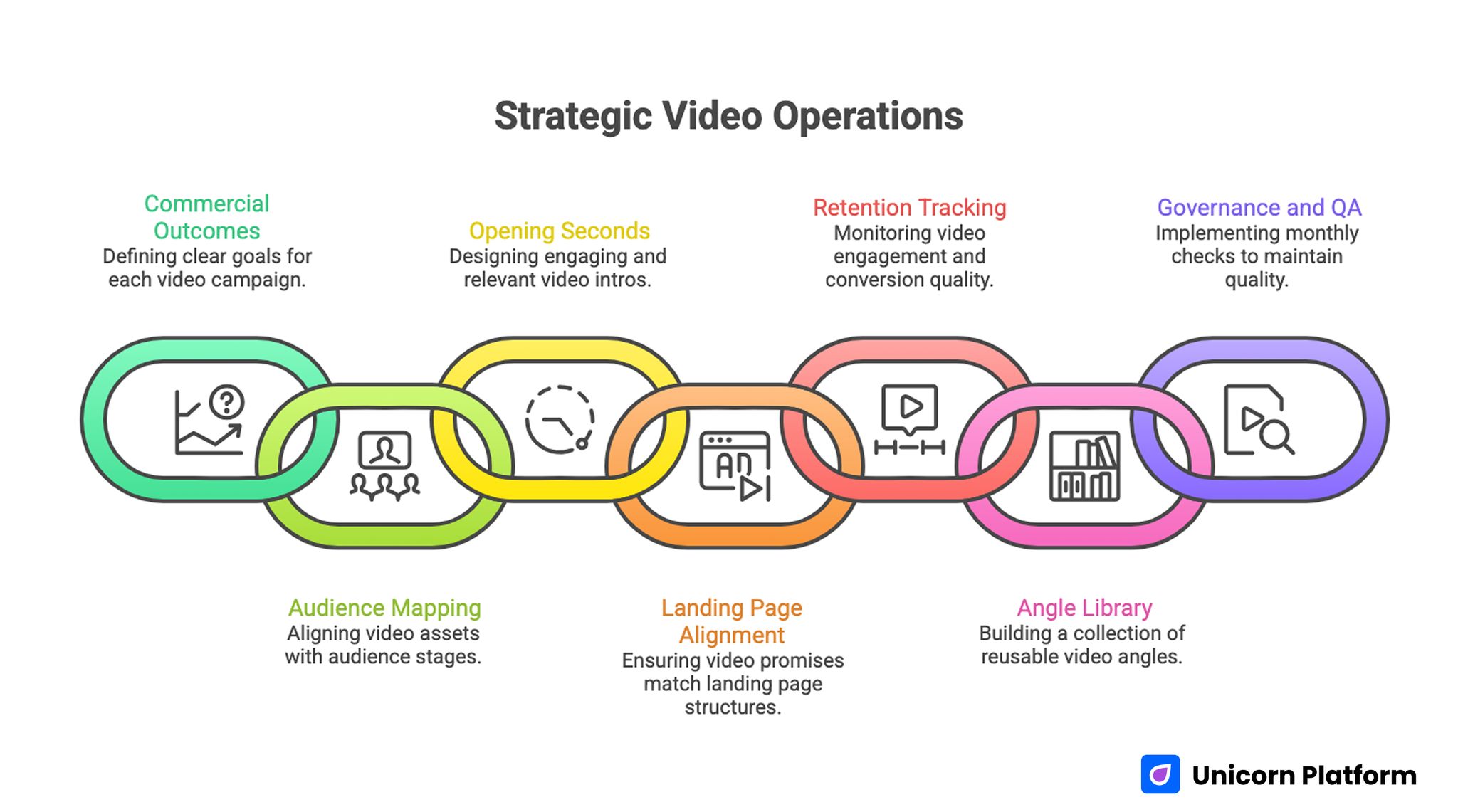
Strategic Video Operations
- Define one primary commercial outcome for each video campaign.
- Map each asset to audience stage before scripting and production.
- Design opening seconds for relevance clarity, not only visual novelty.
- Match video promise with landing-page structure and CTA depth.
- Track retention and route-level conversion quality together.
- Build a reusable angle library to sustain output quality.
- Use monthly governance and QA to prevent drift.
Why Startup Video Programs Underperform
Most underperformance comes from fragmentation. One person owns creative, another owns paid distribution, and another owns landing pages, but no one owns the full behavior path from first impression to qualified action.
A second issue is metric selection. Views and watch totals can look strong while lead quality and pipeline progression remain weak. When teams optimize for easy metrics, campaign decisions drift away from business outcomes.
A third issue is weak message continuity. The video opens with a specific promise, then the landing route pivots to generic product language. That mismatch creates immediate trust loss and early drop-off.
Outcome-First Campaign Architecture
Every campaign should begin with one measurable goal: qualified demo request, trial start from the right segment, sales-assisted lead, or pipeline-stage progression.
Once the goal is clear, script and distribution decisions become easier. Teams can decide what proof belongs in the video, what detail belongs on the page, and what level of CTA friction is appropriate.
If the team needs stronger planning discipline before production, the framework in data-driven SEO strategies for content opportunities is useful for prioritizing demand-aligned routes.
Audience and Buying-Stage Mapping
One video cannot serve all buyer stages equally. Early-stage viewers need relevance and tension clarity, while evaluation-stage viewers need implementation confidence and risk reduction.
A practical map uses three stage groups. Discovery stage focuses on problem recognition. Evaluation stage focuses on proof and fit. Decision stage focuses on operational trust and next-step clarity.
Map every video to one stage and one audience. This avoids diluted messaging and improves route-level conversion quality.
Opening-Frame Strategy That Stops Scroll Behavior
The opening moment should communicate context quickly. Viewers decide in seconds whether the content is relevant to their problem, role, and urgency.
High-performing openings usually combine explicit tension with specific payoff direction. A clear “what changes if you keep watching” signal outperforms abstract brand openers.
Muted playback conditions should be assumed by default. On-screen language and visual structure need to carry meaning without audio dependency.
Narrative Design for Decision Progression
Startup videos perform better when narrative sequence mirrors buying behavior. Strong structure usually follows this order: problem pressure, practical pathway, proof, and next action.
Feature dumping interrupts momentum because viewers cannot translate capability lists into business consequences. Narrative should prioritize implications before details.
A useful script test is simple: can a viewer explain the problem, the mechanism, and the next step after one watch? If not, the narrative is too diffuse.
Production Standards for Lean Teams
High budget is not required for high performance. Clarity, pacing, and credibility matter more than cinematic polish in most startup categories.
A lean quality baseline includes intelligible audio, stable framing, readable captions, concise visual rhythm, and clear transitions between narrative steps.
Production effort should scale only after message-market fit is validated. Overspending before narrative validation usually increases waste and slows learning.
Channel-Specific Distribution Logic
Distribution strategy should adapt the same core narrative to channel behavior. Paid social requires immediate relevance cues. Search-discovery contexts often require clearer educational framing. Email usually supports mid-funnel confidence building.
Creative adaptation should focus on intros, proof format, and CTA intensity rather than rewriting the whole argument for each channel.
Channel planning should also include landing-route match rules. A high-friction CTA from low-intent channels usually suppresses qualified progression.
Landing Path Alignment: Where Conversion Quality Is Won
Video performance cannot be separated from destination quality. If the page does not resolve the tension introduced in the video, conversion quality drops even with strong watch metrics.
Landing routes should mirror the same promise hierarchy: relevance, proof, implementation clarity, and action. This continuity reduces cognitive reset between watch and click.
For teams refining route architecture depth, a beginner's guide to building a podcast landing page provides practical structure patterns for trust and action sequencing.
Measurement Hierarchy Beyond Reach
A strong measurement stack includes four layers: retention quality, click behavior, route conversion quality, and downstream sales signal quality. According to HubSpot, marketers who track deeper metrics like conversion and engagement quality consistently report better ROI from video compared to those focused only on views and impressions.
Retention quality answers whether narrative holds attention for the right segment. Click behavior answers whether the offer is compelling enough to continue. Route conversion quality answers whether landing structure supports decision completion. Downstream quality answers whether submissions are commercially useful.
Monthly reviews should include all four layers. Isolating one layer can create false confidence and poor resource decisions.
Creative Angle Library for Consistent Output
Teams often slow down because each video starts from a blank concept. A reusable angle library solves this by defining repeatable narrative patterns tied to audience-stage needs.
Practical angle groups include cost of inaction, myth versus reality, implementation walkthrough, objection response, benchmark teardown, and scenario comparison.
Angle libraries improve throughput without sacrificing strategic coherence. Contributors can move faster because narrative intent is predefined before script drafting starts.
Founder-Led and Product-Led Video Balance
Founder-led assets can build trust in new or skeptical categories where market confidence is low. Product-led assets perform better when buyers need interaction proof and implementation detail.
A hybrid model often works best. Founder framing provides conviction and context, then product segments provide evidence and operational clarity.
Route mapping should reflect this difference. Founder-led traffic may need more narrative trust depth, while product-led traffic may need stronger comparison and integration sections.
Repurposing Without Narrative Loss
Repurposing is valuable only when each derivative asset preserves intent clarity. Random clipping can create reach while weakening message quality.
A strong repurposing workflow maps each derivative to one audience-stage objective and one destination route. This keeps content volume aligned with decision value.
If lifecycle nurture is part of the strategy, the fastest way to build a newsletter subscription landing page helps design low-friction continuation paths for viewers not ready to convert immediately.
Budget Allocation for Lean Growth Teams
Early spend should prioritize message validation over production expansion. Low-cost tests can identify which tension and proof combinations actually improve qualified behavior.
After validation, scale spend in layers: broader distribution, richer production variants, then channel-specific expansion. This sequence protects budget from premature optimization.
Budget reviews should compare cost per qualified progression, not only cost per view or click. Qualification economics matter more than impression efficiency.
Risk Management in Video Claims
Aggressive claims can inflate engagement and erode trust if proof is weak. Teams should define claim standards before publishing: what evidence is required, what caveats are mandatory, and which words are restricted in high-risk statements.
Risk policy should cover scripts, captions, thumbnails, and landing copy because inconsistency across elements can create compliance and reputation problems.
Claim governance improves long-term campaign durability. Trust compounds when accuracy is consistent across repeated exposures.
Cross-Functional Operating Cadence
High-performing programs run a consistent weekly loop. Marketing brings retention and route metrics. Sales brings objection patterns. Product brings implementation and roadmap clarity relevant to upcoming narratives.
Each cycle should output one prioritized adjustment for the next release. Small controlled changes produce cleaner learning than broad simultaneous revisions.
A monthly strategic review should reassess angle mix, route priorities, and channel allocation based on qualified outcomes.
QA Workflow Before Publish
A pre-publish QA gate should verify hook clarity, message continuity, caption readability, CTA alignment, tracking integrity, and route quality on mobile. This gate should run before scheduling distribution, not after launch.
QA should also verify source-to-route mapping so each distribution channel sends users to the intended destination path with matching promise language. Mismatch at this step is a common cause of avoidable drop-off.
For teams in Unicorn Platform, this gate is most effective when added directly to the publishing checklist instead of handled as an optional review step. Operationalizing QA in the workflow keeps quality consistent during high-volume launch periods.
30-60-90 Day Rollout Plan
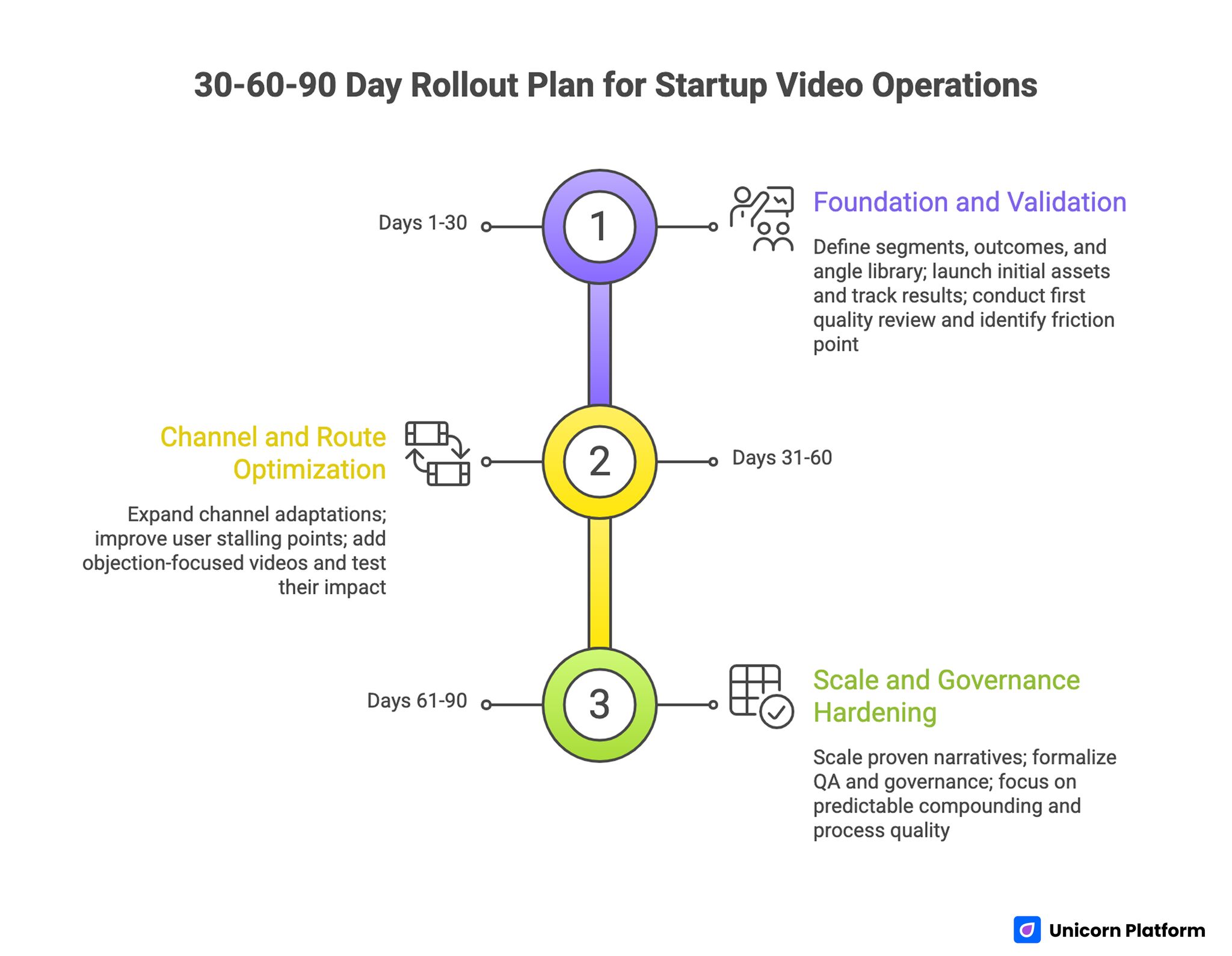
30-60-90 Day Rollout Plan for Startup Video Operations
Days 1-30: Foundation and Validation
Define target segments, campaign outcomes, and initial angle library. Produce a focused asset set and launch matched routes with baseline tracking.
Run first retention and conversion quality review, then identify one high-friction point to improve in the next cycle. Early wins should focus on message-route continuity rather than creative reshoots.
Days 31-60: Channel and Route Optimization
Expand channel adaptations for winning narratives while preserving core message structure. Improve route sections where users stall after click.
Add objection-focused videos based on sales-call patterns and test their effect on qualified progression. This keeps content tightly connected to real buying concerns.
Days 61-90: Scale and Governance Hardening
Scale proven narratives and retire low-signal assets. Formalize QA rules, claim standards, and monthly decision governance.
At this stage, the goal is predictable compounding, not raw content volume growth. Stable process quality is usually a better growth lever than aggressive output expansion.
Executive Scorecard and Budget Triggers
Video programs become easier to scale when budget decisions follow clear performance triggers. Without explicit thresholds, teams often overinvest in channels with high activity and low qualification value.
A practical scorecard should include four blocks: retention quality by audience stage, route conversion quality by source, pipeline-quality movement by campaign family, and operational efficiency metrics such as production cycle time and QA pass rate. Reviewing these blocks together prevents optimization in one area from hiding damage in another.
Budget triggers should be predefined. If retention remains high but route conversion drops, teams should prioritize landing-path adjustments before increasing media spend. If route conversion improves while lead quality declines, teams should tighten audience targeting and message scope before expanding distribution.
The same logic works for production investment. Higher production budgets should be approved only after message patterns prove conversion reliability across at least two campaign cycles. This sequencing protects lean teams from costly creative expansion before strategic fit is validated.
Executive visibility improves when scorecards show decision implications, not just status. Each monthly review should end with one scale decision, one correction decision, and one risk to monitor.
Asset Portfolio Governance and Lifecycle
Startup teams often treat each video as a one-off campaign object. Portfolio thinking works better because assets can be reused, adapted, and retired based on measurable performance over time.
A portfolio model starts with classification. Tag assets by audience, stage, narrative angle, and destination route. This makes reuse intentional and reduces duplicate production effort across sprints.
Lifecycle governance should include clear states: active, monitor, refresh, and retire. Active assets drive qualified outcomes consistently. Monitor assets show mixed performance and need tighter diagnostics. Refresh assets have strategic value but require narrative or proof updates. Retire assets no longer match positioning or route strategy.
Refresh decisions should focus on the highest-leverage variable first. In many cases, updating opening frames and first-screen route alignment delivers better returns than full re-editing. Structured refresh routines keep the portfolio performant without exhausting production capacity.
Governance also improves onboarding. New contributors can understand which assets are trusted, which are experimental, and which patterns should be avoided. This reduces inconsistency as teams scale.
Common Failure Patterns and Fixes
Failure: Reach-Centric Optimization
Teams optimize view metrics while qualified outcomes stay flat. Fix this by elevating conversion-quality metrics in weekly decisions.
Failure: Message-Route Mismatch
Video promise and destination experience diverge. Fix this by enforcing one narrative model across script and landing sections.
Failure: Overproduction Before Validation
Budgets are consumed before signal quality is known. Fix this with phased spend tied to proven narrative performance.
Failure: One Asset for All Stages
A single creative is asked to serve every intent level. Fix this with stage-specific variants and route-specific CTA depth.
Failure: Inconsistent Claims
Strong hooks overpromise relative to proof. Fix this with explicit claim governance and evidence standards.
Failure: No Operating Cadence
Campaigns are launched without structured learning loops. Fix this with weekly tactical reviews and monthly strategic reassessment.
FAQ: Startup Video Operations in 2026
How many videos should a startup publish per month?
Publish only what can be tied to clear route objectives and measured quality outcomes. Smaller, high-clarity output usually beats high-volume noise.
Should we prioritize short-form or long-form first?
Prioritize based on audience stage and goal. Short-form often captures attention, while longer formats often support evaluation confidence.
What metric should be watched first?
Start with qualified progression from video source to route action. It connects content quality directly to commercial behavior.
Can founder-led video outperform product demos?
Yes, especially when trust is low and category understanding is weak. Product evidence should still support the narrative before action.
How do we reduce drop-off after video click?
Improve message continuity between opening promise and first-screen route content. Most drop-off is caused by expectation mismatch.
How often should scripts be revised?
Revise whenever retention or route quality signals show recurring friction. Monthly script refresh is common in fast-moving categories.
Is repurposing always worth it?
Only when each derivative has clear stage intent and destination alignment. Repurposing without context weakens performance.
How do small teams manage QA without slowing down?
Use a compact checklist with explicit owners and include it in the publishing flow. Consistency saves time over repeated rework.
What indicates the program is maturing?
Stronger qualified progression, cleaner attribution, faster iteration cycles, and more predictable pipeline influence across channels. Maturing programs also show fewer high-variance swings between monthly cycles.
What is the most common strategic mistake?
Treating video as creative output only. Durable performance requires integrated operations from script through landing conversion and review cycles.
Another practical maturity signal is handoff quality after conversion events. If sales and customer-success teams can explain the viewer context, narrative angle, and expected outcome without re-discovery, campaign alignment is improving. When handoff context is missing, teams usually compensate with longer calls and lower close efficiency.
Operationally, this means campaign teams should track not only acquisition metrics but also post-conversion usability of lead context. A short monthly audit of handoff notes can reveal whether scripts and destination routes are attracting the intended audience profile.
Teams that sustain this audit loop usually improve forecasting quality as well. When campaign intent, route behavior, and sales outcomes stay aligned over repeated cycles, planning becomes faster and budget allocation becomes less reactive.
That consistency compounds strategic confidence over longer growth horizons.
Final Takeaway
Video becomes a growth engine when creative execution and conversion operations run as one system. Teams that align hook, narrative, proof, distribution, and route experience consistently outperform view-centric programs.
With Unicorn Platform, this system can be implemented quickly and improved in disciplined cycles as audience behavior and market conditions evolve. Consistent governance turns that speed into durable growth rather than short-lived spikes.

