Table of Contents
- Before You Clear: Choose the Right Level
- Unicorn Platform Mobile Release Workflow (Practical Version)
- Mistakes to Avoid
- FAQ
When pages load incorrectly on iPhone, many people assume the site is broken. Often, the problem is local website data: old cache files, stale cookies, and saved session artifacts that no longer match the current version of a page.
For Unicorn Platform users, this matters even more. If you publish frequent page updates, run A/B variants, or edit conversion sections quickly, cached mobile data can make a freshly updated page appear outdated. Clearing website data is one of the fastest ways to confirm whether the issue is in the page itself or only in the device state.
This guide explains when to clear website data, how to do it safely in Safari, Chrome, and Firefox, and how to use a simple mobile QA routine so your Unicorn Platform pages are tested on clean conditions.
sbb-itb-bf47c9b
Key Takeaways
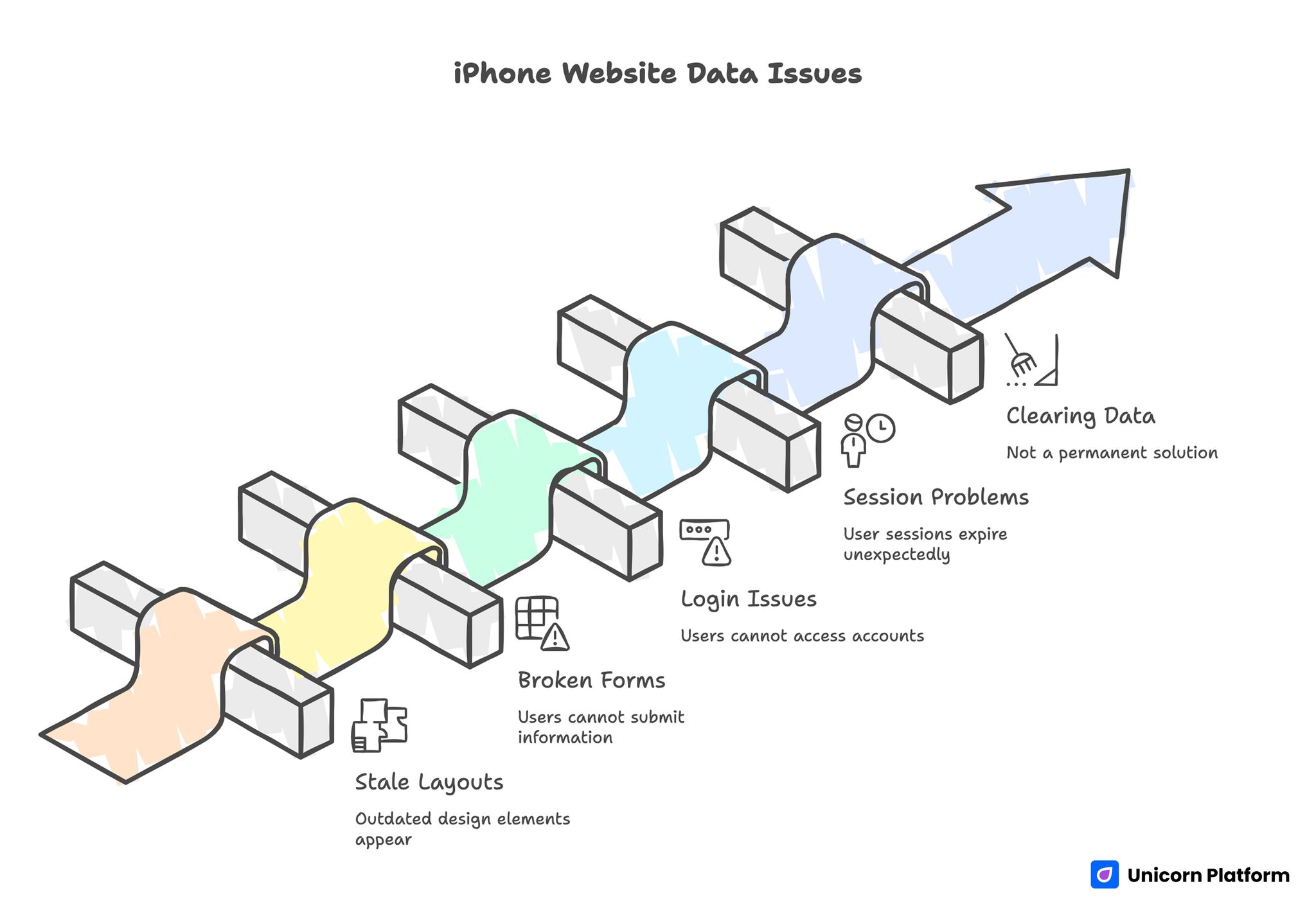
IPhone Website Data Issues
- Old iPhone website data can cause stale layouts, broken form behavior, and login/session issues.
- Clear data only as deeply as needed: single-site first, full-browser reset only if necessary.
- Safari gives the most granular control for iPhone website data management.
- Chrome and Firefox require slightly different clearing paths, especially for cached files.
- Unicorn Platform teams should use a repeatable mobile check routine after publishing major page updates.
- Clearing data is a diagnostic step, not a permanent substitute for technical fixes.
Why Clearing Website Data on iPhone Helps
Website data stored on iPhone improves speed and convenience in normal use. The tradeoff is that old local data can conflict with new page versions. This is common after redesigns, script updates, consent banner changes, or form logic edits.
When the local browser state is stale, users may see old images, outdated layout spacing, unexpected redirects, or form submission errors that do not appear on other devices. In these cases, clearing website data can immediately restore normal behavior.
For support and QA workflows, this step is also valuable because it isolates variables. If the issue disappears after clearing data, the root cause is likely local state. If it remains, you can focus on the page, integrations, or tracking setup.
Before You Clear: Choose the Right Level
Not every issue requires a full reset. Start with the smallest change that can test your hypothesis.
Level 1: Private browsing test
Open the page in private mode first. If the problem disappears there, local stored data is probably involved.
Level 2: Clear data for one site
If one domain behaves badly, remove website data for that domain only. This preserves data for other sites.
Level 3: Full browser data clear
Use this only when issues are broad, repeated, or spread across many sites. This resets more aggressively and may sign you out of accounts.
Choosing levels in this order keeps diagnosis clean and avoids unnecessary disruption.
Safari on iPhone: Step-by-Step
Safari is the default browser for most iPhone users and the most common context for mobile page validation.
Clear all Safari history and website data
- Open Settings.
- Scroll to Safari.
- Tap Clear History and Website Data.
- Confirm the action.
This removes browsing history, cookies, and cached website resources. It is fast, but broad.
Clear data for one specific website in Safari
- Open Settings.
- Go to Safari.
- Tap Advanced.
- Tap Website Data.
- Search for the domain.
- Swipe left on that domain and tap Delete.
This is the preferred method when debugging one Unicorn Platform project URL.
When to use each Safari option
Use full clear when behavior is inconsistent across many sites or across multiple sessions. Use single-site clearing when one landing page or subdomain is affected.
For frequent editors, single-site clearing gives better control and less account disruption.
Chrome on iPhone: Step-by-Step
If your audience or team validates pages in Chrome iOS, use Chrome’s own data clearing options instead of Safari settings.
- Open Chrome.
- Tap the menu icon.
- Go to History.
- Tap Clear Browsing Data.
- Select a time range.
- Choose data types (history, cookies, cached images/files).
- Confirm clear.
For page debugging, cached files and cookies are usually the most important selections. If the issue is login/session behavior, include cookies. If visual assets are stale, include cached files.
Firefox on iPhone: Step-by-Step
Firefox users can clear data from inside app settings.
- Open Firefox.
- Open the menu.
- Go to Settings.
- Tap Data Management.
- Select what to remove (cache, cookies, browsing data).
- Confirm clear.
As with other browsers, avoid clearing everything by default unless troubleshooting requires it.
Common Situations Where This Solves the Problem
Updated page still shows old design
Cause is often cached CSS, JS, or image files. Clearing cached data usually refreshes the rendered version.
Form works on desktop but not on iPhone
Old session state or cookie conflicts can interfere with form logic. Clearing site data often resolves this quickly.
Consent banner or popups behave incorrectly
Persisted consent and script state can conflict after updates. Clearing domain data gives a clean behavior check.
Repeated login/logout loops
Corrupted or stale cookies can trigger authentication loops. Cookie reset is a common fix.
How to Apply This in Unicorn Platform
If you manage pages in Unicorn Platform, use this short mobile QA workflow after major updates.
Mobile publish check (fast version)
- Publish page changes.
- Open the page in private browsing on iPhone.
- Open the same page in normal browsing.
- If behavior differs, clear data for that domain.
- Re-test form, CTA, and key conversion path.
This process quickly identifies whether the issue is browser state or page logic.
Team support workflow
When users report "the page looks wrong on iPhone," ask support to run three checks in order:
- Private browsing test
- Domain-level data clear
- Full browser clear (only if needed)
Then collect screenshot + iOS version + browser version + page URL. This keeps troubleshooting structured and avoids random guesswork.
Content operations tip
If your team publishes frequent landing-page edits in Unicorn Platform, add a short "mobile cache check" item to your release checklist. It reduces false bug reports and helps teams validate what real users will see after updates.
Data Clearing vs Storage Cleaning
Browser data clearing is for page-state issues. General phone storage cleaning is a separate task.
If your iPhone storage is heavily constrained, tools like Clever Cleaner can help with broader cleanup, while deeper storage-oriented steps are explained in this blog post.
Use both actions for different goals: website-data clearing for browsing behavior, storage cleanup for overall device health.
Advanced Troubleshooting Matrix for iPhone Page Issues
When basic clearing does not solve the issue, move to symptom-based diagnosis. This avoids random fixes and gives faster resolution.
Symptom: old page design still appears after publish
Run a private-mode check first. If private mode shows the new version, clear site data for the domain and reload. If both modes still show the old version, verify that the published URL is correct and that the right page version is live.
For Unicorn Platform users, also confirm that edits were published to the same page slug users are opening. A slug mismatch can look like a cache problem when it is actually a publishing path issue.
Symptom: CTA or form button does not respond on iPhone
Clear domain data, then test without content blockers. Some blocker rules can interfere with scripts tied to forms and popups. If behavior improves, adjust script usage or provide a cleaner fallback path in the page flow.
Also test on both Wi-Fi and mobile data once. Network-level filtering sometimes affects script loading in ways that resemble broken page logic.
Symptom: user is unexpectedly logged out or redirected
This usually points to stale or conflicting cookies. Clear domain data and repeat the login path from a fresh session. If the issue repeats, inspect redirect logic and session assumptions in your flow.
In practical support work, this step often resolves account-path friction quickly without deeper code changes.
Symptom: only one browser shows the issue
If Safari fails but Chrome works, or the reverse, that is a strong hint the root cause is browser-specific local state or browser-specific behavior. Keep troubleshooting in the failing browser instead of switching immediately to global fixes.
Document the browser and version in your issue note. Reproducibility is much better when support logs this data from the start.
Unicorn Platform Mobile Release Workflow (Practical Version)
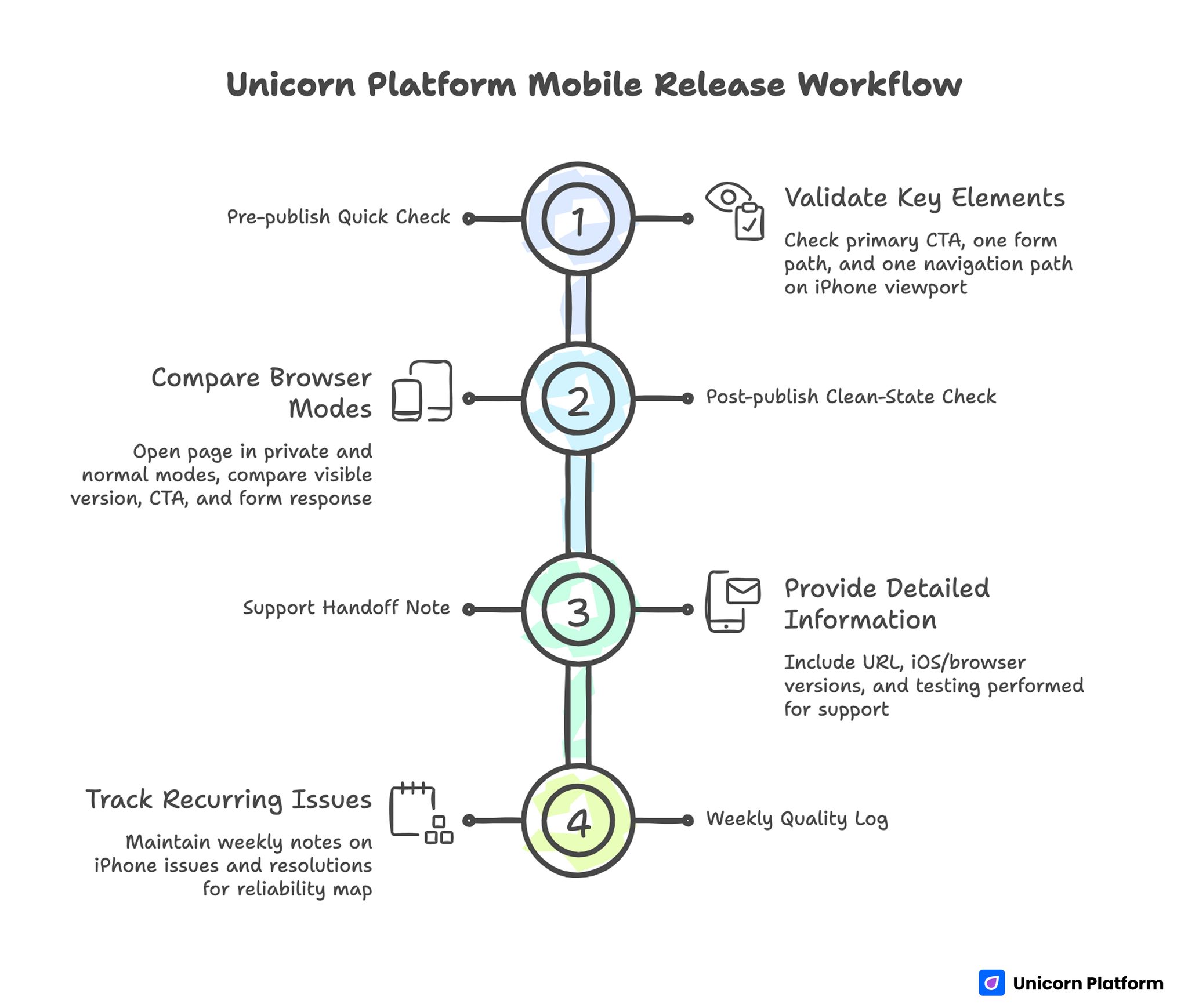
Unicorn Platform Mobile Release Workflow
For teams publishing often, this workflow keeps mobile quality stable with minimal overhead.
Step 1: Pre-publish quick check
- Validate primary CTA text and destination
- Validate one form submission path
- Validate one navigation path on iPhone viewport
Step 2: Post-publish clean-state check
- Open page in private mode
- Open page in normal mode
- Compare visible version, CTA behavior, and form response
If results differ, clear domain data and repeat the check. This confirms whether local browser state is part of the problem.
Step 3: Support handoff note
When handing off to support, include:
- Exact page URL
- iOS version
- Browser version
- What was already tested (private, domain clear, full clear)
This prevents repeated duplicate checks and speeds resolution.
Step 4: Weekly quality log
Maintain a short weekly note with recurring iPhone issues and resolved causes. Over time, this becomes a useful reliability map for your Unicorn Platform pages and helps prevent repeated incidents.
Mistakes to Avoid
Clearing everything too early
A full browser reset can remove useful sessions and history. Start with domain-level clearing whenever possible.
Testing only once after clearing
Run at least two checks: initial load and one repeat interaction. Some issues appear only after first session initialization.
Mixing browser results
Safari, Chrome, and Firefox can produce different behavior because each app manages local data differently. Validate in the browser your users report.
Ignoring iOS and browser version context
Always note versions when logging issues. Without version context, repeated problems are harder to reproduce.
Treating cache-clearing as a permanent fix
If issues return consistently, investigate scripts, integrations, asset versions, and form logic. Clearing data is a diagnosis step, not the final technical remedy.
Practical iPhone QA Checklist for Landing Pages
Use this after major updates:
- Test in private mode first
- Test in normal mode second
- Clear site data for the exact domain if mismatch appears
- Re-test hero section, media, and first CTA
- Submit one form end-to-end
- Verify thank-you page or confirmation state
- Record iOS/browser version and screenshot for any anomaly
This checklist is short enough for daily use and strong enough to catch most mobile state issues.
FAQ
Will clearing website data delete my iPhone photos or apps?
No. It affects browser-related data such as history, cookies, and cached files, not your photos or installed apps.
Should I clear Safari history or only website data?
For debugging one site, domain-level data removal is usually better. Full history clearing is broader and often unnecessary.
Why does my page look old on iPhone but new on desktop?
The most common cause is stale local browser cache on iPhone. Clear site data and re-check.
How often should I clear website data?
Only when troubleshooting or when browser behavior is clearly stale. Routine weekly clearing is usually not needed.
Is private browsing enough for testing?
It is a strong first diagnostic step. If private mode and normal mode differ, clear domain data next.
Can cookie issues break forms?
Yes. Old or conflicting cookie state can affect form sessions, consent logic, and redirects.
Does this process help Unicorn Platform users specifically?
Yes. It is useful for anyone publishing frequent page updates and validating mobile conversion paths on iPhone.
What if clearing data does not fix the issue?
Move to technical diagnostics: inspect scripts, integrations, redirect rules, and page assets under controlled test conditions.
Should support teams ask users to clear all data immediately?
No. Start with targeted steps to reduce disruption and improve signal quality.
What is the fastest reliable troubleshooting order?
Private mode test, domain-level clear, then full clear only if the issue remains.
Final Takeaway
Clearing website data on iPhone is one of the fastest ways to resolve stale mobile page behavior and isolate local-browser issues from real page defects.
For Unicorn Platform users, the key is consistency: apply the same mobile check order after updates, use domain-level clears before full resets, and keep troubleshooting evidence structured. That makes your pages easier to validate and your support workflow much faster.