Table of Contents
- Why Random Testimonial Use Underperforms
- Feedback Collection by Journey Stage
- 30-Day Rollout Plan
- Common Mistakes and Fixes
- FAQ
Most teams collect testimonials in bursts. A customer sends kind words, someone captures the quote, and the quote appears on a page without context or update plan. It looks like progress, but it rarely behaves like a true growth asset.
High-performing teams do something different. They treat customer voice as a managed evidence system. They collect feedback intentionally, classify it by decision stage, verify usage rights, deploy it where objections occur, and refresh it as products and audiences evolve. That process turns social proof from decorative content into conversion infrastructure.
This matters because buyers are more skeptical and better informed than before. They do not need more claims. They need credible evidence that the outcome they care about is realistic for someone like them. If proof is generic or outdated, trust weakens quickly.
This guide explains how to build a complete testimonial and feedback system for startups and growth teams. It covers collection, segmentation, placement, governance, measurement, and iteration so trust can improve with every release cycle.
sbb-itb-bf47c9b
Key Takeaways
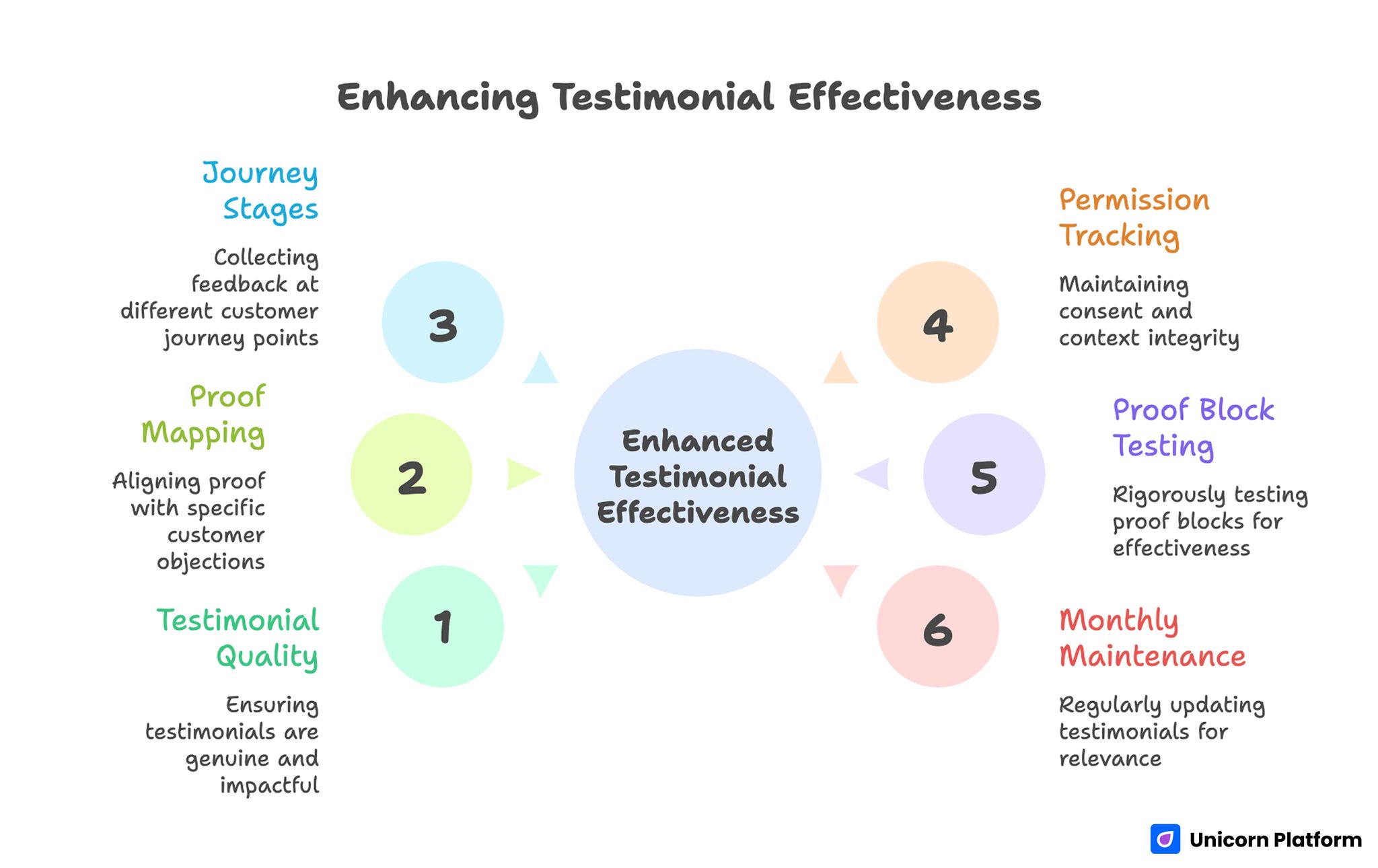
Enhancing Testimonial Effectiveness
- Testimonial quality matters more than testimonial quantity.
- Proof should be mapped to specific objections, not added randomly.
- Feedback collection should be structured by customer journey stage.
- Permission tracking and context integrity are non-negotiable.
- Proof blocks should be tested with the same rigor as headlines and forms.
- Monthly maintenance is required to keep evidence relevant and credible.
Why Random Testimonial Use Underperforms
Most weak proof systems fail for predictable reasons. The first reason is vagueness. Quotes like "Great service" or "Loved it" provide emotional positivity but no decision guidance. Prospects still do not know whether your offer solves their specific problem. Research from Nielsen Norman Group shows that vague testimonials without context or specific outcomes have significantly lower credibility and persuasive impact. Users rely on concrete details such as role, use case, and measurable results to evaluate whether a product is relevant to their situation. This reinforces the importance of structured, high-signal proof instead of generic praise.
The second reason is context loss. Teams often remove surrounding details to make quotes shorter, but that can strip the part that made the quote persuasive in the first place. Without role, use case, or result context, proof becomes less believable.
The third reason is placement mismatch. Testimonial blocks are often placed in one section far from decision friction points. Users then encounter objections at forms or pricing sections without nearby evidence to resolve them.
The fourth reason is staleness. Proof that was compelling a year ago may now reference outdated workflows, old product versions, or irrelevant market context. Stale evidence silently reduces trust.
A strong system addresses all four issues with process, not guesswork. Once workflow discipline is in place, trust signals improve predictably instead of by luck.
The Evidence Operations Model
A practical model for feedback-driven trust has five stages. Each stage can be owned by a clear role so execution stays consistent as volume grows.
- Collect: gather feedback at meaningful journey moments.
- Classify: tag feedback by theme, segment, and objection type.
- Curate: select high-signal proof with specific decision value.
- Deploy: place evidence where hesitation occurs.
- Review: measure impact and refresh routinely.
This model is simple enough for small teams but robust enough for scaling programs. The advantage is consistency. Every testimonial is treated as part of a system, not as isolated content.
Teams applying this in Unicorn Platform can pair proof placement with strong page flow design. For example, this high-converting landing page structure guide helps decide where evidence has the highest conversion impact.
Feedback Collection by Journey Stage
Collection strategy should match customer context. Asking every user the same broad question produces low-value responses.
A better approach is stage-based prompting. Different moments produce different insights, so the prompt should match the moment.
Post-Onboarding Prompts
At this stage, ask about setup clarity, time-to-first-value, and early friction. These responses are useful for trust blocks related to implementation concerns.
Post-Outcome Prompts
After customers see measurable benefit, ask what changed, what was hard before, and what became easier. These responses are often strongest for conversion-stage proof.
Support-Resolution Prompts
After a support interaction, ask about responsiveness, clarity, and confidence recovery. These insights are useful for trust objections around reliability and service quality.
Renewal or Expansion Prompts
At later stages, ask why customers stayed, expanded, or recommended the product. These responses strengthen credibility for higher-consideration buyers.
Prompt design should prioritize specificity. Questions that ask for concrete before-and-after context consistently produce stronger proof than satisfaction-only questions.
What High-Signal Testimonials Look Like
Strong testimonials usually include four parts: context, challenge, action, and result. Even in short form, these elements can be preserved with concise editing. Examples analyzed by HubSpot consistently highlight that the most effective testimonials include clear before-and-after scenarios, specific challenges, and tangible outcomes. Testimonials that combine narrative clarity with measurable impact tend to outperform general endorsements, especially on high-intent pages.
Context tells readers whether the example matches their situation. Challenge highlights the decision tension. Action shows how the solution was used. Result clarifies what changed.
For example, a high-signal quote might mention that onboarding time dropped from weeks to days after adopting a structured workflow. That is far more persuasive than broad praise because it answers a specific buyer question.
When editing testimonials, keep meaning intact. Improve readability, but avoid rewriting in ways that introduce claims the customer did not make.
Proof Segmentation for Better Relevance
One shared testimonial block cannot serve every audience equally. Different buyers care about different forms of risk.
A practical segmentation structure can include the categories below. Use only the tags your team can maintain consistently.
- Persona segment (founder, operator, marketer, procurement).
- Use case segment (launch, optimization, migration, scale).
- Risk segment (implementation risk, performance risk, support risk).
- Funnel stage segment (discovery, consideration, conversion).
Segmented proof libraries make it easier to deploy relevant evidence quickly. They also reduce the temptation to overuse a small set of generic quotes.
Teams that run inbound qualification flows can connect this segmentation to page intent design. This lead generation framework is useful when mapping proof to form-stage quality goals.
Placement Strategy: Evidence at Friction Points
Testimonial placement should follow objection flow, not visual symmetry. Put evidence where users hesitate.
Common high-impact zones include the sections below. These locations usually have the highest hesitation before action.
- Near pricing or plan comparison sections.
- Beside form submission CTAs.
- Next to implementation-related claims.
- Adjacent to risk-sensitive policy language.
Placement can be tested empirically. If support-ticket volume indicates recurring concerns about speed or reliability, move relevant proof closer to those claims and measure behavior changes.
A distributed evidence strategy usually outperforms one isolated testimonial carousel because users receive reassurance at the moment they need it. This pattern also keeps pages easier to scan because proof appears in context.
Text, Video, and Hybrid Proof Formats
No single format is best in every context. Text is lightweight and scalable. Video adds emotional and tonal depth. Hybrid systems often perform best.
Text snippets are effective for quick trust checks around CTA areas. Video clips can support mid-funnel sections where users need richer context. Screenshot proof can work when authenticity cues matter, but only if source clarity is preserved.
Format should match decision complexity. Low-friction decisions benefit from concise proof. Higher-consideration decisions often need deeper narrative evidence.
A useful workflow is to collect broad text feedback continuously, then identify top-performing stories for video follow-up. This gives teams volume and depth without overloading production.
Negative Feedback as Trust Reinforcement
Many teams avoid public mention of criticism, but balanced transparency can improve credibility. Prospects often trust teams more when they see how issues were handled, not only how outcomes were celebrated.
A practical approach is to show problem-resolution narratives where appropriate: what concern existed, what actions were taken, and what changed afterward. This demonstrates responsiveness and operational maturity.
Balanced proof should still be curated responsibly. The goal is not to surface every complaint, but to show credible improvement patterns tied to customer outcomes.
Internally, negative feedback should feed copy and product decisions quickly. If recurring objections appear in support channels, those objections should influence public messaging and FAQ updates.
Governance: Permissions, Accuracy, and Compliance
Testimonial operations require governance to protect trust and reduce risk. At minimum, teams should track consent status, source channel, edit history, and refresh date for every public proof asset.
Permission handling should be explicit, especially when names, logos, photos, or videos are used. If permission scope changes, updates should propagate across all pages where the testimonial appears.
Accuracy standards are equally important. Do not change meaning during editing. Do not attribute outcomes to users that were not stated. Do not strip qualifiers that materially affect interpretation.
Governance can stay lightweight, but it cannot be optional. As proof libraries scale, weak controls create brand and legal exposure quickly.
Feedback Platform Selection by Workflow Fit
Choosing a feedback tool should be a workflow decision, not a feature checklist race. The right platform is the one your team can run consistently.
Selection criteria should include the points below. Evaluate tools against workflow fit, not only feature lists.
- Ease of collecting stage-based feedback.
- Tagging and filtering by objection themes.
- Permission and source tracking support.
- Export and deployment compatibility with page workflows.
- Reporting clarity for business stakeholders.
If a platform cannot support fast feedback-to-page loops, it becomes a storage layer rather than a growth lever. Speed from insight to deployment is what determines business value.
For teams combining proof operations with lifecycle messaging, this newsletter conversion guide can help align trust evidence with retention communication pathways. This alignment improves consistency between acquisition and post-conversion messaging.
Measurement Framework for Proof Impact
Proof optimization should be measured with behavior and outcome metrics, not just content activity metrics. Otherwise teams may optimize visual interaction while conversion quality stalls.
A practical measurement stack can include the indicators below. Review them together to avoid one-dimensional decisions.
- Interaction rate with testimonial modules.
- CTA conversion near proof blocks.
- Form completion quality by proof variant.
- Objection-related support-ticket frequency.
- Conversion quality movement after proof updates.
Use guardrails. If interaction goes up but qualified conversion declines, the proof may be attracting curiosity without fit.
Path-level analysis is especially useful. Evaluate which combinations of proof and page sections precede high-quality conversions, then reinforce those pathways in templates.
30-Day Rollout Plan
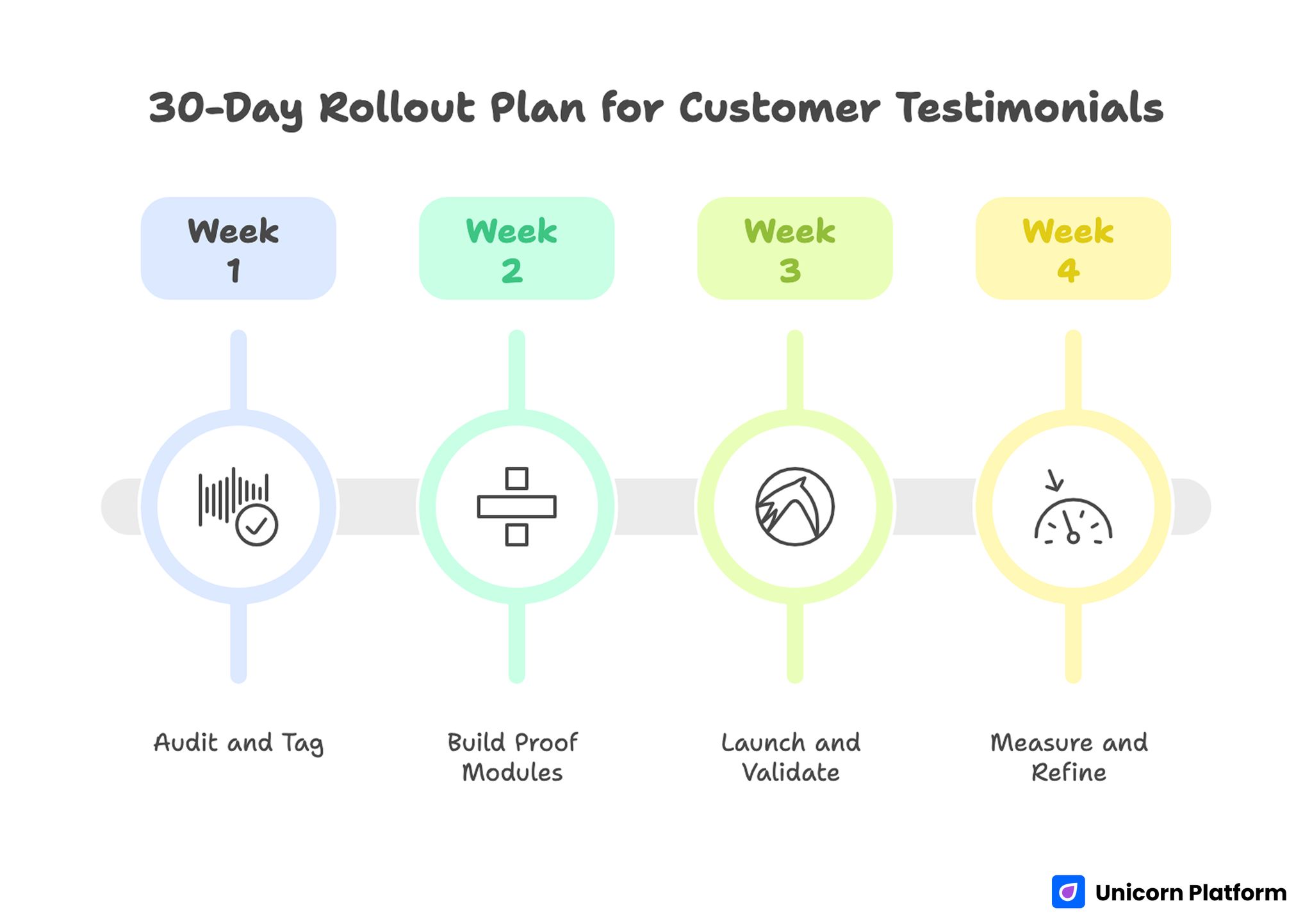
30-Day Rollout Plan for Customer Testimonials
Week 1: Audit and Tag
Collect recent testimonials and feedback signals, then classify by segment, objection type, and journey stage. Remove stale or unverified entries.
Week 2: Build Proof Modules
Create reusable proof components for high-friction areas such as pricing, implementation, and support trust. Define placement rules by page intent.
Week 3: Launch and Validate
Deploy proof modules on one high-intent page and one supporting page. Validate mobile readability, consent integrity, and narrative clarity.
Week 4: Measure and Refine
Review conversion-quality signals and support outcomes. Replace one low-performing proof block and test one placement adjustment.
Repeat monthly so evidence quality compounds rather than decays. Consistent cadence usually outperforms occasional large cleanups.
Quarterly Roadmap for Proof Maturity
Monthly iterations improve page quality, but quarterly planning is where systems mature. A quarterly roadmap helps teams move from reactive quote updates to repeatable evidence operations that influence conversion outcomes and internal decision-making.
In quarter one, focus on foundations: collection prompts, taxonomy rules, permission tracking, and core placement standards on high-intent pages. In quarter two, expand into segmentation depth by persona, offer type, and objection theme so proof becomes more relevant by context. In quarter three, refine experimentation discipline with controlled placement tests and clear guardrail metrics. In quarter four, standardize what worked into templates and retire low-value patterns.
This phased approach keeps complexity manageable. Teams avoid building heavy process too early while still creating a path toward stronger trust systems over time. The result is a proof library that becomes more accurate, more useful, and easier to activate each cycle.
Quarterly planning should also include cross-team reviews with support, sales, and product contributors. These teams often see emerging objections before marketing dashboards do. Bringing those insights into roadmap planning helps testimonial systems stay aligned with real customer behavior instead of static assumptions.
Scenario Playbooks
Scenario 1: High Traffic, Low Trust Conversion
A startup drives strong traffic to comparison pages but sees weak form completion. Analysis shows proof blocks are generic and distant from decision points. Replacing broad quotes with context-rich testimonials near CTA sections often improves confidence and submission quality.
Scenario 2: Strong Lead Volume, Weak Qualification
A service team receives many inquiries but spends significant time disqualifying poor-fit leads. Their testimonial set emphasizes enthusiasm but lacks scope and process clarity. Adding segmented proof around project fit and delivery expectations usually improves lead relevance.
Scenario 3: Fast Growth, Proof Quality Drift
A scaling team collects more testimonials but loses consistency in permissions and context quality. Introducing governance rules, refresh dates, and standardized editing guidelines stabilizes trust signals and reduces risk.
Common Mistakes and Fixes
Mistake 1: Publishing testimonials without context
Fix: Include role, use case, or outcome framing so readers can evaluate relevance. Context is what turns a quote into decision support.
Mistake 2: Keeping all proof in one section
Fix: Distribute proof near objection points across the page journey. Placement should follow user hesitation, not page symmetry.
Mistake 3: Over-editing customer language
Fix: Improve readability without changing factual meaning or tone integrity. Over-editing usually harms authenticity and trust.
Mistake 4: Ignoring permission lifecycle
Fix: Track consent status and usage scope for every public asset. Permission governance protects both credibility and compliance.
Mistake 5: Treating stale proof as evergreen
Fix: Run monthly recency audits and replace outdated evidence. Fresh proof is more credible and usually performs better near CTA zones.
Mistake 6: Measuring testimonial success by clicks only
Fix: Tie proof updates to qualified conversion and support outcomes. This keeps optimization linked to business value rather than presentation changes.
FAQ: Customer Testimonial Systems
1. How many testimonials should a page include?
Use enough to resolve major objections without overwhelming readers. A small set of relevant proof usually performs better than a large generic collection.
2. Should we prioritize text or video testimonials?
Start with text for breadth, then add video for high-impact stories that need deeper credibility. This sequence keeps production efficient while increasing persuasive depth.
3. How often should testimonials be refreshed?
High-intent pages should be reviewed monthly for recency, relevance, and permission validity. Review sooner when product messaging or offer structure changes.
4. What makes a testimonial high value?
Specific context, clear challenge, and credible outcome detail tied to a real user scenario. High-value proof helps buyers see a realistic path from problem to result.
5. Can negative feedback be used publicly?
Yes, when presented responsibly as resolution evidence that demonstrates responsiveness and improvement. Balanced transparency often strengthens credibility more than flawless-looking praise.
6. Where should testimonials be placed for best effect?
Near forms, pricing decisions, and other high-friction moments where users need reassurance. Place evidence where decisions are made, not only where design allows extra space.
7. How do we prevent fake-looking testimonials?
Keep source context visible, avoid over-editing, and preserve authentic voice cues. Authentic tone markers help readers trust that feedback is real.
8. What teams should own this workflow?
Assign clear owners for collection, curation, permissions, deployment, and measurement. Shared ownership without role clarity usually leads to inconsistent execution.
9. What metric should we watch first?
Start with qualified conversion movement near proof blocks, then add support and retention indicators. This sequence keeps early measurement simple while preserving outcome focus.
10. What is the first improvement most teams should test?
Test objection-matched testimonial placement near primary CTA sections before expanding proof volume. Placement quality usually drives gains faster than adding more quotes.
Final Takeaway
Customer proof works when it is structured, specific, and continuously maintained. Teams that build evidence operations instead of quote collections create stronger trust signals and better conversion quality over time.
When this system is run consistently in Unicorn Platform, feedback becomes a compounding asset that improves messaging, qualification, and decision confidence across every major page. Over time, this reduces conversion volatility and improves the quality of every new campaign launch.
Related Blog Posts
- Introduction to Customer Feedback Platforms for Startups
- Redditors Share Tips for Creating Personal Websites: What Actually Works in 2026
- Dashboard Landing Pages for Startups: How to Simplify Complex Products and Improve Conversion
- Ebook Page Conversion Strategy in 2026: How Creators Turn Attention Into Qualified Action

