Table of Contents
- Niche Selection Scorecard That Reduces Guesswork
- Most Promising Affiliate Niche Clusters in 2026
- PPC Validation Framework for Affiliate Niches
- 30-Day Execution Plan for a New Affiliate Niche
- Common Mistakes That Kill Affiliate Margins
- FAQ
Most affiliate projects do not fail because people pick a "bad" niche. They fail because niche choice is treated as a one-time decision instead of an operating system with clear economics, validation rules, and execution discipline.
A niche can look promising on social media and still lose money after real traffic hits the page. Search demand might be high, but buying intent could be weak. Commission rates might look attractive, but refund rates or paid acquisition costs can erase margin fast.
The strongest affiliate operators in 2026 treat niche selection as the start of a process: score the opportunity, validate intent, test conversion paths, and scale only what is commercially durable.
This guide gives you that full process. You will learn how to evaluate profitable segments, avoid beginner traps, validate with PPC without burning budget, and build a scalable affiliate engine with structured pages in Unicorn Platform.
If you are improving organic acquisition alongside affiliate growth, this breakdown of link building agency review criteria can help refine authority strategy for competitive verticals.
sbb-itb-bf47c9b
Quick Strategic Takeaways
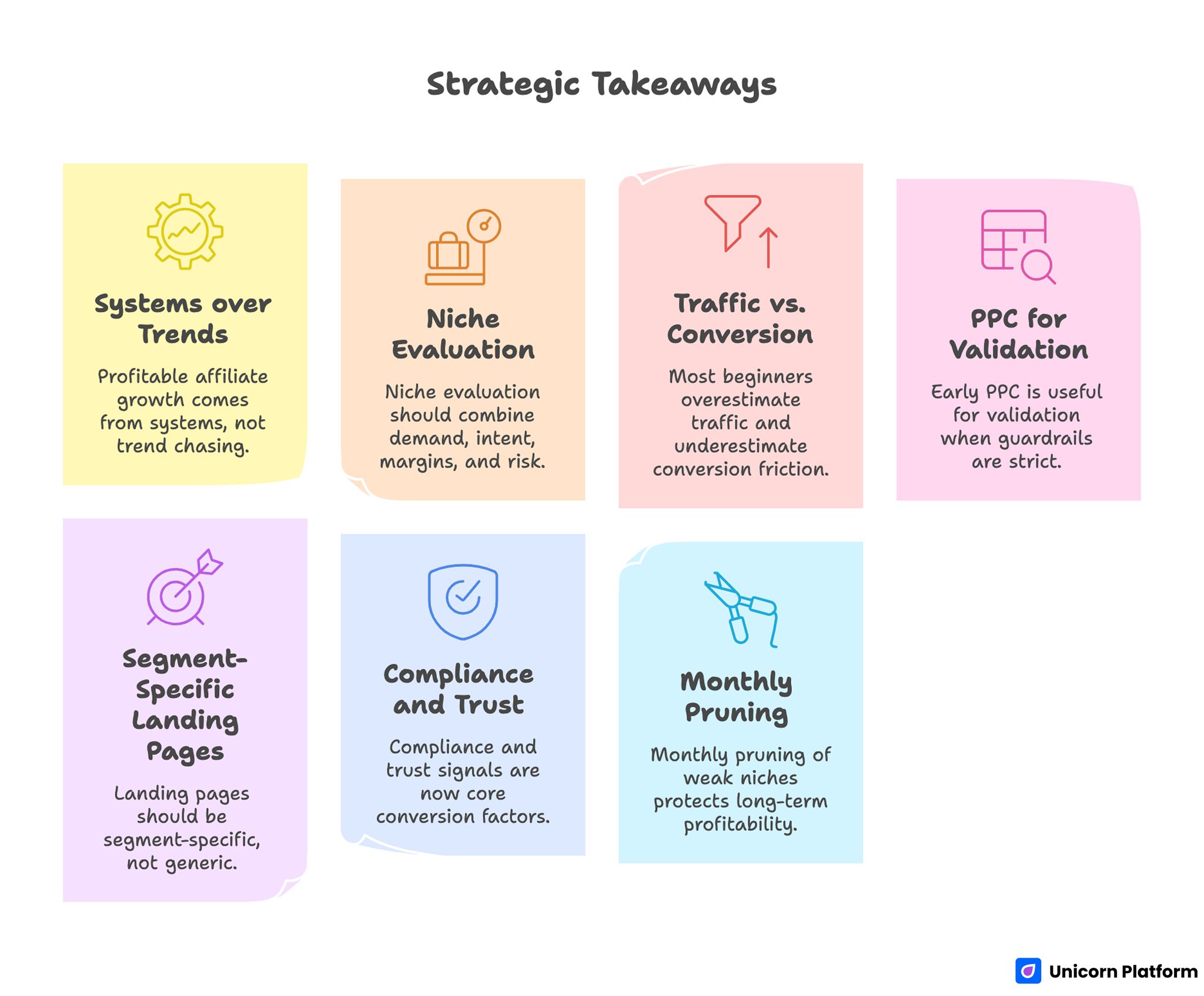
Strategic Takeaways for Building a Profitable Affiliate Niche System
- Profitable affiliate growth comes from systems, not trend chasing.
- Niche evaluation should combine demand, intent, margins, and risk.
- Most beginners overestimate traffic and underestimate conversion friction.
- Early PPC is useful for validation when guardrails are strict.
- Landing pages should be segment-specific, not generic.
- Compliance and trust signals are now core conversion factors.
- Monthly pruning of weak niches protects long-term profitability.
Why Affiliate Niches Changed Between 2023 and 2026
Older niche-list searches still appear in user behavior, but the market has shifted. Legacy niche roundups are not useless, yet they cannot be copied directly because competition, user expectations, and platform policies are different now.
Three structural changes define 2026 performance. First, competition is denser in almost every high-intent vertical. Second, users are more skeptical of generic recommendation content and expect clearer proof. Third, compliance and disclosure standards are enforced more consistently across ad platforms and partner programs.
That means niche selection should focus less on headline traffic numbers and more on operational fit. Your team needs to win on clarity, trust, and economics, not on publishing volume alone.
For teams that want a stronger decision framework before scaling output, this practical guide on aligning website optimization with business goals is useful for tying page strategy to revenue outcomes.
Niche Selection Scorecard That Reduces Guesswork
A practical scorecard helps you avoid emotional decisions. Rate each niche from 1 to 5 across the criteria below, then reject any niche with two or more weak categories.
1) Demand durability
Check whether demand is stable across seasons and whether interest can survive short hype cycles. Durable niches usually have recurring problems and repeat purchases.
2) Buyer intent quality
Look for decision-near behavior, not only informational curiosity. Queries around comparisons, alternatives, and use-case fit are often stronger than broad definitions.
3) Commission economics
Model expected earnings against acquisition and content costs. A niche with lower commission can still win if conversion rate and retention quality are stronger.
4) Competitive defensibility
Evaluate whether you can produce better positioning, proof, and depth than current pages. If incumbents are deeply entrenched and differentiated, the entry cost may be too high.
5) Compliance and policy risk
Some categories involve stricter legal, disclosure, or platform policies. Higher risk can still be viable, but you need tighter editorial and tracking controls.
6) Operational sustainability
Ask whether your team can consistently create trustworthy content and keep offers updated. A niche that requires high maintenance without clear upside may become a drag.
This scorecard removes a lot of beginner noise. It also makes stakeholder discussions clearer because each niche can be compared on consistent business logic.
Most Promising Affiliate Niche Clusters in 2026
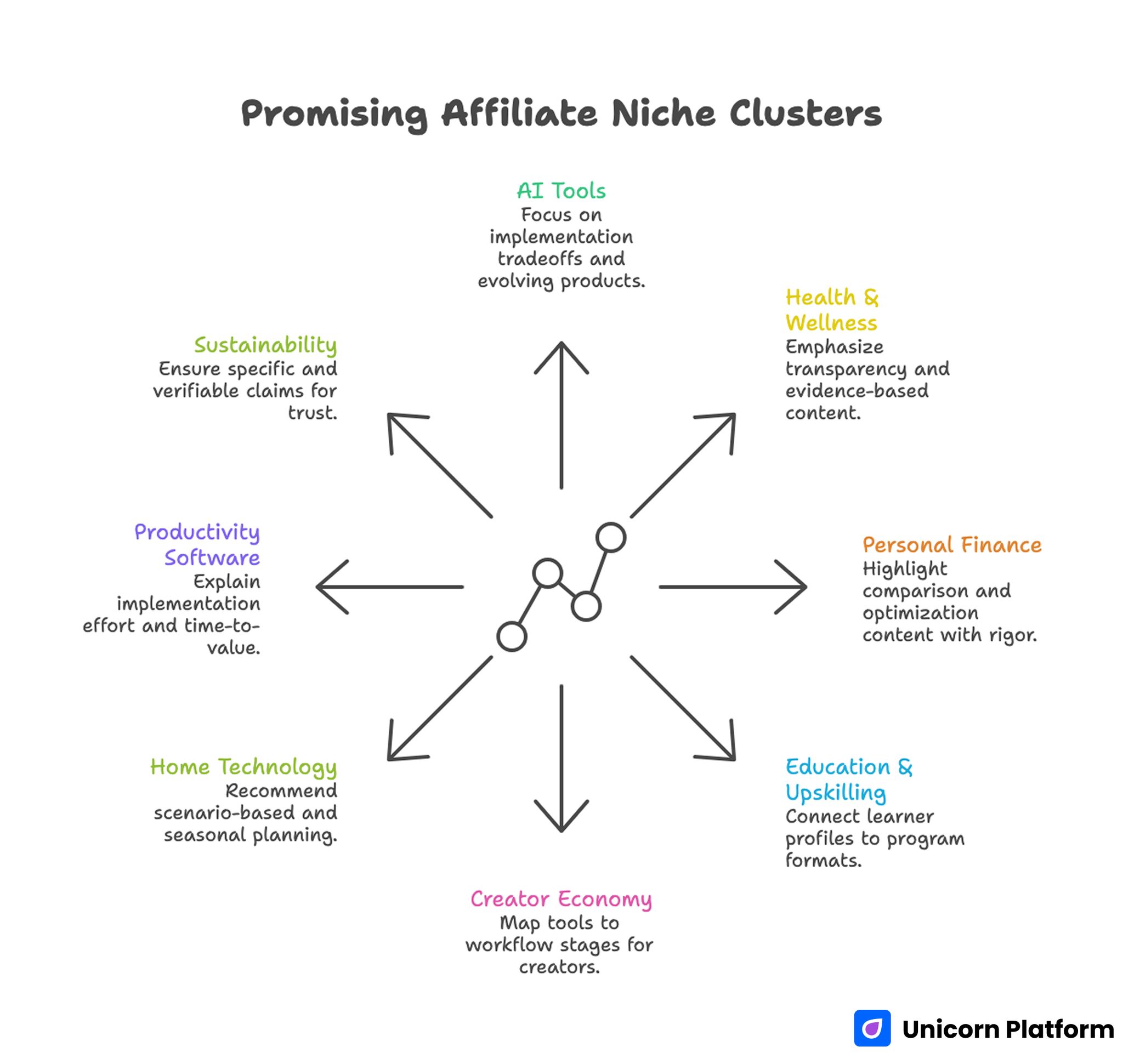
Promising Affiliate Niche Clusters
No niche is automatically profitable, but some clusters show stronger structural conditions right now when executed well.
AI tools and SaaS workflows
This cluster remains strong because products evolve fast and users actively compare solutions. Opportunity is highest where you can explain implementation tradeoffs, not just list features.
Health, fitness, and wellness programs
Demand is large and persistent, but trust standards are high. Transparent disclosure and evidence-based framing are essential for long-term conversion quality.
Personal finance and wealth tools
Intent is often high, especially for comparison and optimization content. Competitive pressure and compliance expectations are both significant, so editorial rigor matters.
Education, upskilling, and career transitions
Recurring demand and clear outcome-driven positioning make this cluster attractive. Conversion improves when content ties specific learner profiles to specific program formats.
Creator economy and audience growth tools
Creators actively test software and service stacks, which supports affiliate behavior. Pages perform best when they map tools to workflow stages instead of generic "best tools" lists.
Home technology and smart devices
This niche can perform well with scenario-based recommendations and seasonal planning. Logistics, returns, and margin volatility should be tracked closely.
Productivity and business operations software
B2B and prosumer audiences often produce higher-value conversions. Strong pages explain implementation effort, onboarding complexity, and likely time-to-value.
Sustainability and eco-conscious product lines
This area can convert well with the right audience match, but trust is fragile. Claims must be specific and verifiable to avoid skepticism.
How Beginners Should Choose a Profitable First Niche
Beginners usually improve outcomes faster by choosing a focused micro-niche instead of broad market categories. A narrower starting point reduces content complexity and makes signal interpretation cleaner.
Use this seven-step approach:
- Pick one audience profile with one clear purchasing problem.
- Build a seed list of related queries by intent stage.
- Score 10-15 offer options with the niche scorecard.
- Select one primary offer path and one fallback path.
- Publish a focused landing page and one comparison page.
- Run low-budget validation traffic for clean signal.
- Keep, refine, or drop the niche based on economics.
This structure is intentionally simple. Simplicity is useful in early stages because it helps you learn quickly without operational overload.
Acquisition Strategy: SEO, PPC, and Partner Traffic in One System
High-performing affiliate teams do not treat channels as separate worlds. They align message and intent across search, paid traffic, and partner referrals so users see a consistent promise after the click.
Start with SEO for durable intent capture and category authority. Use PPC to accelerate signal collection, not to replace strategic content work. Use partner traffic selectively when partner quality and messaging standards are well controlled.
When teams test new discovery channels, this tactical resource on web directory submission for SEO workflows can support additional qualified visibility without turning into low-quality link spam.
Channel alignment is the core rule. If ad copy promises one result and landing pages lead with different framing, conversion quality drops quickly.
PPC Validation Framework for Affiliate Niches
PPC can help validate niche economics quickly, but only when structured as an experiment. The goal is not immediate scale. The goal is to understand whether commercial signals justify deeper investment.
Step 1: Define a strict test hypothesis
Example: "Niche A comparison intent can produce qualified conversions below target acquisition cost with a results-first landing page."
Step 2: Use small, capped test budgets
Set a fixed budget ceiling for each test window. Budget discipline protects learning quality by forcing you to prioritize high-signal variables.
Step 3: Build one page per intent cluster
Do not send multiple ad groups to one broad page. Intent-matched pages make results easier to diagnose and improve.
Step 4: Track quality, not only click cost
Cheap clicks are irrelevant if conversion quality is weak. Include lead quality, payout reliability, and refund-adjusted economics in your test review.
Step 5: Stop weak tests quickly
Shut down low-margin or low-trust segments early. Resource concentration on viable segments is a major performance advantage.
This method is how PPC becomes a practical validation layer rather than a budget drain.
Build an In-House Affiliate Program the Right Way
Many teams stay focused on external affiliate marketplaces and miss the upside of their own partner program. Internal programs can improve control, partner quality, and long-term economics when your offer and margins are mature enough.
Launch readiness usually requires four basics: clear partner fit criteria, transparent payout logic, reliable tracking, and reusable promotional assets.
A strong program page should answer partner questions before onboarding: who is accepted, what is paid, how attribution works, what claims are allowed, and when payouts are processed.
Program quality often depends more on enablement than on recruitment volume. Ten aligned partners with clear resources usually outperform a large, unmanaged partner list.
Landing-Page Architecture for Affiliate Conversion
Affiliate pages should not be isolated blog posts with random links. They should function as a structured decision path from discovery to evaluation to action.
Core page stack
- Niche pillar page: market map, decision criteria, and intent routing.
- Comparison pages: use-case-specific tradeoffs and fit guidance.
- Offer pages: clear economics, disclosures, and focused CTAs.
- Partner program page: requirements, payouts, and support resources.
In Unicorn Platform, this structure is easier to maintain because each segment can have dedicated pages without heavy development cycles. Teams can test positioning and proof blocks quickly, then scale only the versions that produce qualified outcomes.
Trust block placement
Put credibility elements near commitment points, not only at the bottom of long pages. Useful trust elements include transparent disclosure, short results context, and practical recommendation criteria.
Trust is not decorative. In affiliate contexts, trust is one of the strongest conversion drivers over time.
Content Strategy That Supports Revenue, Not Vanity Metrics
Affiliate content should help readers decide, not overwhelm them with feature lists. The most useful pages answer real buying questions with context and tradeoff clarity.
A practical content mix includes:
- intent-stage guides for beginners and evaluators
- comparison frameworks for decision-stage readers
- niche-specific troubleshooting content
- post-purchase optimization or onboarding tips
This mix supports the full user journey and increases the chance that early informational traffic eventually becomes conversion-ready traffic.
Update rhythm matters. Outdated comparisons and stale offers quietly destroy trust and distort performance data.
Compliance, Disclosure, and Risk Controls
Compliance is now part of core operations, not a legal afterthought. Disclosure should be clear, readable, and positioned where recommendation influence is strongest.
Risk controls should include partner claim guidelines, suspicious traffic monitoring, and periodic conversion-quality audits. These controls reduce fraud exposure and preserve brand reliability.
If you run high-payout categories, establish alert thresholds for abnormal click and conversion behavior. Early detection can prevent significant margin loss.
In-house partner programs should define enforcement actions early. Clear policy prevents disputes and discourages low-quality tactics.
Metrics That Actually Indicate Affiliate Health
Clicks and impressions are not enough to evaluate niche performance. You need metrics that connect traffic to durable economics.
Track these core indicators monthly:
- revenue per qualified click
- conversion rate by intent cluster
- payout-to-acquisition-cost ratio
- refund-adjusted commission quality
- partner activation and retention rate
- percentage of traffic from high-fit segments
Segment-level reviews are critical. A niche can look healthy in aggregate while one subgroup is quietly unprofitable.
30-Day Execution Plan for a New Affiliate Niche
Week 1: Research and scoring
Build your niche candidate list, apply the scorecard, and remove weak options early. Define the first test hypothesis and target economics before building pages.
Week 2: Page setup and trust assets
Publish one niche page and one comparison page in Unicorn Platform. Add disclosure language, recommendation criteria, and a clear conversion path for each intent stage.
Week 3: Controlled validation traffic
Launch low-budget PPC tests and monitor quality metrics daily. Keep variables limited so you can interpret outcomes without noise.
Week 4: Decision and optimization
Scale the winning segment, revise one underperforming segment, and pause one weak segment if needed. Document what changed and why for the next cycle.
90-Day Scale Plan for Durable Affiliate Growth
Days 1-30: Stabilize the base system
Confirm niche economics, tighten page clarity, and validate attribution reliability. This phase should prioritize predictable conversion quality over raw traffic growth.
Days 31-60: Expand to adjacent micro-niches
Add one or two closely related segments with clear audience overlap. Reuse what worked, but adapt proof and objection handling for each segment.
Days 61-90: Operationalize partner enablement
Launch or refine your partner resource center with approved messaging, creative assets, and support workflow. Strong enablement improves campaign consistency and reduces support burden.
This progression keeps growth controlled and easier to manage under real budget and staffing constraints.
Common Mistakes That Kill Affiliate Margins
Chasing volume without intent quality
High traffic with low buying intent creates workload without revenue. Optimize for qualified intent, not vanity session counts.
Using generic pages for multiple audience types
Broad pages dilute relevance and lower trust. Build segment-specific pages with fit-focused messaging.
Ignoring refund-adjusted economics
Gross commission can look strong while net profitability is weak. Include refunds and support costs in all margin calculations.
Testing too many variables at once
When headlines, audiences, and offers all change together, results are hard to interpret. Controlled experiments produce better decisions.
Treating disclosure as footer-only compliance
Weak disclosure placement increases risk and harms trust. Integrate transparent disclosure near recommendation logic.
Recruiting partners without enablement standards
More partners do not automatically improve outcomes. Alignment and quality controls are what make partner channels scalable.
FAQ: Affiliate Niche Strategy in 2026
Are old affiliate niche lists still useful?
They are useful as a research starting point, not as execution plans. The winning approach is to re-score opportunities with current economics, competition, and compliance requirements.
What is the best affiliate niche for beginners?
There is no universal best niche. The best starting niche is one with clear intent, manageable competition, realistic margins, and content depth your team can sustain.
How much traffic do I need before judging a niche?
You need enough data to evaluate conversion quality and economics, not just click volume. Small but clean validation windows are often better than large noisy tests.
Should beginners use PPC for affiliate testing?
Yes, if budgets are capped and hypotheses are clear. PPC is useful for fast signal collection when tests are disciplined and landing pages are intent-matched.
How do I know if a niche is too competitive?
Check whether top pages are deeply trusted and whether you can produce meaningfully better fit guidance. If differentiation is weak and acquisition costs are high, entry risk rises quickly.
Is it better to join programs or build my own affiliate program?
Joining existing programs is usually faster initially. Building your own program can be powerful later when your offer, margins, and operational controls are mature.
What pages should I build first in Unicorn Platform?
Start with one niche page, one comparison page, and one focused offer page. This gives you enough structure to validate intent and conversion logic without overbuilding.
Which metrics matter more than CTR?
Revenue per qualified click, payout-to-cost ratio, and refund-adjusted commission quality are stronger indicators of durable performance than click-through rate alone.
How often should affiliate pages be updated?
Run light updates weekly and strategic reviews monthly. Offer changes, pricing shifts, and policy updates should trigger faster revisions when needed.
What is the biggest long-term mistake in affiliate growth?
Treating affiliate work as isolated content production is the biggest mistake. Long-term performance comes from a connected system of niche selection, page architecture, validation, and partner operations.
Final Takeaway
Affiliate growth in 2026 is a systems game. The teams that win do not just find popular niches. They score opportunities rigorously, validate intent with discipline, manage risk, and scale only what is economically strong.
With Unicorn Platform, you can turn affiliate niche research into a practical operating workflow: segment-specific pages, faster testing cycles, clearer trust structure, and partner enablement that supports long-term revenue quality.
